Showing posts with label Saturn. Show all posts

Tuesday, December 30, 2025

A Night of Near Ring-Plane Crossing and a Titan Transit

As we close out 2025, Saturn offered one last moment of subtle drama before it passes Eastern quadrature on its way to a springtime Solar conjunction. On the evening of November 22nd, Towson enjoyed a brief window of clear skies – just enough for me to take in a rare combination of events: a Titan transit that was already in progress as dusk fell, and Saturn’s rings appearing as thin as we would see them all year (in fact, as thin as we’ll see them for the next 15 years!). The true ring-plane crossing back in the spring was lost to solar conjunction, so this November evening became the next closest recreation of the event.

Visual Attempt with the 6-inch RV6

My goal was simple but ambitious: could I visually detect Titan’s silhouette against Saturn’s disk during the transit? I began the session with my trusty 6" RV‑6 reflector on the HEM27 mount. Unfortunately, the mount was having a rough go of it. About every ten seconds or so it would stutter, just enough to be annoying but not enough to prevent visual work. 

I tried a few eyepiece combinations and filters in search of the “sweet spot” for the observation. I began with the excellent 8mm TMB eyepiece with a light green filter, but the image seemed a tad small at 150x. I then swapped that out for the Celestron Ultima Edge 15mm with the 2.5× TeleVue Barlow, yielding a still crisp view at 200x.

The seeing would occasionally steady for a few brief moments as the planet drifted silently by with the tracking turned off, floating through the field as if using a Dob. The ring shadow was unmistakable and striking as a crisp, dark line slicing across the globe. With the rings nearly edge-on, they looked like a taut thread stretched across the planet. Subtle dusky shading flanked the ring plane in both hemispheres, though neither side stood out more strongly.

But Titan itself? After twenty minutes of careful, unstrained observing with me perched on a stool peering into the eyepiece, I had to concede defeat. Whether it was the limits of the 6-inch aperture, the low contrast of the event, or simply my older eyes, the moon’s silhouette never definitively popped into view.

Imaging Session

After wrapping up the visual attempt, I moved to the front driveway where the Cyrus 10" Newtonian had been cooling. By 8 p.m. I was capturing data through the Baader 685 nm deep red filter. The seeing was average at best, perhaps even slipping below that as the night went on, and transparency hovered around 6–7/10 with a haze creeping in by a little after 9 p.m.

Even so, Saturn was rewarding. The rings were astonishingly thin on the live feed displayed on the laptop, and both the north and south equatorial belts were faintly visible. At 8:21 p.m. I noticed Titan as a small dot hugging the planet’s limb, promising an interesting capture from the night’s effort. I also played with the settings a bit, increasing the gain and exposure to brighten the disk and improve the odds of recording Titan and maybe another of the smaller moons. Conditions continued to deteriorate as we headed towards 9 o’clock, and with haze thickening I decided not to stay out to try to include a Jupiter run in the evening’s efforts.

Final Images

The processed results from the 10-inch show Saturn in its late‑2025 austerity: a nearly ringless world with a bold shadow line and muted atmospheric bands that are far better defined using the deep red filter. The WL (white light) image required some work to bring out any coloration. The composed final image which blends the color shot with the IR as the luminance channel serves as a satisfying souvenir of the 2025 near ring crossing event.


Tuesday, October 28, 2025

A Shadow Missed But A Surge Gained

On the evening of September 19th, I was gearing up to record one of the final Titan shadow transits of the season. An ALPO colleague had tipped me off to the upcoming event, a rare alignment that won’t grace our skies again until August 2038. If I’m still around at 83, I’ll be chasing it again. Luckily, for this particular event the forecast from Astropheric promised above-average seeing, and I was eager to make the most of it.

Knowing the transit window would be brief (just 2.5 hours, with only a portion ideal for imaging) I prepped the scope early, aligning the finder and checking collimation before trying (unsuccessfully) to grab a few hours of sleep. By 1 a.m., I was back outside, scope thermally settled, laptop in hand, and Saturn hanging clear in the sky.

I began imaging with the ASI178MC, focusing on the northern polar region where Titan’s shadow should have been visible. But something seemed off. The shadow normally is like taking a paper punch to the globe, creating a very high-contrast object that is readily detected. Even the disk of Titan, with a much lower albedo level compared to the clouds, should have been evident. I dutifully continued on capturing AVI runs, thinking perhaps I just needed to be closer to mid-transit for it to be visible on the laptop monitor. 

As we approached 2 a.m. I decided to do a quick processing run to investigate the situation.  The mystery was promptly solved by the outcome: I had miscalculated the Universal Time conversion. The transit wasn’t happening for another 24 hours. A rookie mistake - one I’d like to blame on the emotional fog of having been laid off from my SSA contract earlier that day. That’s my story, and I’m sticking to it!

Still, the seeing was solid, so I pressed on. I captured both white light and Baader 685nm “Deep Red” filtered images, the latter always better at teasing out Saturn’s atmospheric banding. Of course, the grayscale results of the Baader image lack the visual charm of color, but I’d recently watched a tutorial by Damian Peach on blending R-IR data as a luminance layer with color images. The video skipped a few key steps, so I played around in Photoshop and sought the advice of my friend Steve Stewart (a PS master), experimenting until I found a technique that worked. The final composite was well worth the effort - sharp, detailed, and visually satisfying.


One surprise emerged during processing: the rings were noticeably brighter than in my earlier summer captures. Comparing the September 19th image to one from July, the difference was striking. Then it hit me. Saturn was mere hours from opposition on the 21st. Could this be the Seeliger effect, the so-called “opposition surge”? It certainly looked that way. The rings, previously muted, had taken on a luminous sheen, likely due to the Sun-Saturn-Earth alignment minimizing shadows and maximizing reflectivity.


I’ll be curious to see if the rings dim again in my next imaging session. For now, I’ll chalk this night up as a win despite the missed transit. The imaging run delivered a beautiful Saturn and a reminder that even a seasoned observer with half a century behind the eyepiece can still slip up. 

Thursday, July 31, 2025

Achieving a Bucket List Item

There are certain astronomical events that intersect our lives only episodically, and Titan shadow transits has been one of those elusive moments for me. Years ago, as a young amateur seeing Jupiter’s moons cast their shadows on the giant planet, I wondered why I did not see that with Saturn. Of course, I soon realized that Saturnian moons do not do this routinely due to the planet’s axial tilt of 27°, lifting (or dropping) their orbits so that they don’t cut in front of the planet when it is facing the Sun. Only when Saturn is around the time of its equinox (when its rings appear very thin) do the moons begin to intersect the Sun’s plane as they move in front of their host planet. We are roughly halfway through such a season with the ringed planet having reached autumnal equinox for its Northern hemisphere last May. I know that only a few months remain of this opportunity, my last realistic chance for years to come. The next similar alignment won’t take place until 2038, at which point I’ll be a much older observer, perhaps with a little more wisdom but a little less stamina for predawn adventures.

Given that Titan orbits the planet every 16 days these transits will take place only once or twice a month. And given that the orbit is almost exactly 16 days you have to be on the right side of Earth with Saturn in a reasonably dark sky. Thankfully the Western hemisphere is well position for the current series. The window opened as Saturn emerged from Solar conjunction this spring. My concerns of missing it have been slowly nagging me as I watched the May and June windows be clouded out and the July 2nd opportunity unavailable as I was away.

July 18th was on my calendar as the next transit, but as it approached it came with iffy forecasts: some sources predicted hopelessly thick clouds, while others suggested there might just be enough breaks to make an attempt worthwhile. I set my alarm anyway and, with a quiet stubbornness familiar to many amateur astronomers, rose at 3:15 a.m. to scan the skies. It was quite overcast but there still were occasional breaks through which Saturn would pop out for a few minutes. I rolled out the Cyrus 10” f/6 Newtonian and performed a quick mirror collimation.

I decided to prioritize visual observation rather than seeing it on a laptop screen, wanting to witness this event with my own eyes. When a sizable break appeared a little after 4 a.m., I popped in my 8mm TMB eyepiece and Meade 2x Barlow and brought the planet into focus. Perched on the first rung of my step ladder, I saw the planet as a light tan orb with the rings as a spike through it. I continued studying the planet, waiting for those fleeting moments of steady seeing. My first micro-glimpse was uncertain – did I see something or was it a trick from my aging eyes? But after a couple of minutes the dark dot continued to pop in & out of view, clinching it as the shadow of Saturn’s largest moon.


All too soon the clouds reclaimed the view. I swapped out the eyepiece for camera in hopes they would relent for a few minutes so that I could grab an image of the event. But it was an hour of frustration as the planet never emerged for an encore. But while the imaging effort failed, it was a pure delight and sense of accomplishment to witness that shadow cast across another world.

Last week the forecast for early Thursday morning caught my attention with partly cloudy skies and predicted above average seeing – rare conditions for this spring and early summer of 2025. Unable to pass on the prospect, I set out the Cyrus scope around 10 p.m. and settled in for a short rest with the alarm set for 3 a.m. As usual I ended up naturally waking up ahead of the alarm – odd how your body will do that! 

As I stepped outside I was greeted by warm, muggy air; just the sort of atmospheric hush that can often presage very good seeing. The malingering clouds were punctuated by generous breaks, one of which framed Saturn. I started the usual pre-observing sequence: mirror collimation, finder alignment before commanding the scope slew to Saturn. I centered it on the laptop screen and honed the focus, using the high-contrast edge of the rings' black shadow on Saturn’s bright equator as my guide.

Imaging began in the deep red/infrared wavelength using a Baader 685 filter, firing off five 2-minute video runs. Next I changed camera filters to begin a run of color captures. I did a quick stack and sharpen of one of the early video captures and was happy that it revealed delicate banding and even a hint of the Cassini Division. Encouraged by seeing conditions nudging up to 8/10, I pressed on to take a total of nine videos. Then with the laptop battery flagging I invested in capturing a nearby star’s Airy disk as a sharpening reference, managing two short videos before the battery gave up a little after 5 a.m. Time to pack it in and get ready for work!

The next day’s processing brought a pleasant surprise with the best Saturn images I’ve had in months. The R/IR set showcased layered bands, with the NEB and SEB standing out sharply. I was especially intrigued by the dark SPR, perhaps a lingering effect from Saturn’s long winter. The rings, though dim, opened enough to reveal the Cassini Division at their tips, while the planet’s shadow starkly cut off the rings where they ducked behind the globe.


The true showpiece, though, was the color session. Saturn’s pastel hues—blue to tan—came through beautifully. Again, the NEB and SEB dominated, while the SPR, though less sharply defined, was the darkest and bluest region on the disk. What caught my eye most was a subtle bluish belt in the NTR region, around latitude +50°, visible in each of the nine runs, so surely not an artifact. I’ll be curious to see if it turns up again in my next imaging session.


Observing opportunities given the lousy weather seem to come at a premium these days, especially when a quick shower and heading out to work follows your pre-dawn session. But these two sessions this month made every lost minute of sleep worth it. And among the many milestones, I can now add the thrill of witnessing a Titan Transit shadow—a sight I’ll not soon forget. 

Thursday, June 26, 2025

Ghost Rings

It’s been a frustrating few months here—cloudy skies, a rainy spring, and the usual march of obligations that come with being back in the office. But I managed to sneak in a planetary session one Thursday morning before work. Not easy when you’ve got to be clocked in shortly after 6 a.m., but sometimes the sky gives you a narrow window, and you take it.

This was my first planetary observation in quite a while. I had the 10-inch f/6 Newtonian out, laser-collimated and ready. Saturn was hanging low and I didn’t have the time to work the ADC into the train, so I kept things simple. Seeing hovered around 6/10, transparency worse—perhaps a 4/10 thanks to persistent Canadian wildfire smoke over the mid-Atlantic.


Still, I managed a “deep red” imaging run, capturing Saturn shortly after its recent Autumnal Equinox last month. What struck me most when I finally got the planet centered and focused on the laptop screen was how dim the rings appeared.


At such a shallow B ring angle, the rings appeared ghostly, dimmer than I recall seeing them in years. On the laptop, they seemed to fade into the background, lacking the sharp border that can help in achieving focus. Visually, through the 10" at 187x, they were brighter—a shining needle skewering a ball of yarn—but still far from their previous brilliance.


So why the dimming? Some research was in order, and I must admit having AI as an assistant for such things is fantastic.


With us just past equinox the Sun is illuminating the rings edge-on. At this angle, the sunlight strikes the rings so obliquely that their icy particles scatter much less light toward us—especially in red and IR wavelengths. Unlike the globe, which reflects more consistently reflects the light back at the observer, the rings become dramatically muted under these conditions. And with the B angle so close to zero, we’re seeing not only less illumination but also less material: the thin plane of the rings reveals little vertical structure from this 


Interestingly, the rings looked darker than my last deep red image back in January of this year when we were still viewing the northern plane, despite having a similar B angle. The geometry and light-scattering behavior are that sensitive.


As for Saturn itself—the image shows subtle bands representing the NEB and SEB bands, and, interestingly, perhaps a darker SPR region. Overall it’s a small win in less-than-ideal conditions. This isn’t the showiest Saturn I’ve captured, but it’s a subtle reminder of just how dynamic the outer planets can be—not just from year to year, but from month to month in our own observing windows.

Thursday, January 30, 2025

Chasing Planets: January's Observations and Challenges

The media has been hawking the auspicious "planetary parade" that allows an observer to see 6 planets during frosty January evenings. Of course two of those (Uranus and Neptune) are not naked eye objects. I do not mind articles that generate interest in our hobby, but my fear is always the "over promising and under deliver" risk.

However, January was indeed a fun month for us planet observers. Mars was occulted by the nearly Full Moon on the evening of the 13th, and then two days later came to opposition for this apparition. Jupiter was positioned well and decided to throw a major eruption amid its North Tropical Zone southern jet stream on January 10th, garnering a lot of attention. Venus also ascended the Zodiac after lying close to the southwestern horizon most of its current evening apparition, reaching greatest elongation on the 10th heading for its highest altitude in the western sky on February 2nd. The only downside has been the weather with classic winter turbulent seeing amid very cold temps.

Mars Occultation

The skies were clear but quite cold for the occultation of Mars. I set up the 10" Cyrus telescope and verified its collimation. The Moon served as a convenient focus target as I set up about 20 minutes before the scheduled disappearance. I knew that the difference in brightness would be a challenge and thought I'd have time to fiddle with the gain setting right before the occultation, but it happened so fast that I really did not get a great capture with the Moon very overexposed. Still, it was a very cool event to watch the Moon relentlessly approach the red orb and cover it up with about 30 seconds.

The Moon ready to cover Mars

January 17th Session

The evening of the 17th was predicted to have average seeing and temperature right around the freezing mark, which is fairly good for this region in winter. I again set the Cyrus scope out early to cool and verified its collimation. As Venus emerged from encroaching twilight I set to work on capturing our sister planet. 

Starting with the Deep Red filter (642+nm) and no Barlow, Venus provided a bright target upon which to focus. Doing a 5 minute capture resulted in a nice image, showing the planet past dichotomy and a common cue-ball appearance. I have yet to truly discern any cloud details in IR light.


Swapping out the Deep Red filter for an IR-block and UV set, I retargeted the planet and adjusted the settings to bring up the brightness in the fainter UV light. I could make out even on the on-screen image that there was uneven brightness in the sunlight reflecting off the Venusian cloud tops.

Processing produced a nice greyscale image with a some cloud structure. Interestingly, a well defined cusp cap was not really seen, although you might argue one was around the south pole region. This is somewhat in agreement with the UV Venus images I have been seeing submitted to the ALPO for the current evening apparition; cusp caps are not as prominent as I believe they were during the last apparition.

By now Saturn was visible in the deepening twilight, close and to the left of Venus. I figured why not give it one last capture since the upcoming mid-March solar conjunction and my obstructed western horizon meant it would soon be inaccessible. I added the Barlow back into the imaging path and returned to the Deep Red filter. Seeing was not very good, and the rings had closed up again compared to a few months ago. I had enough juice in the laptop for two 2-minute captures, resulting in a sub-par image where it is hard to even detect the globe's shadow being cast against the rings. Au revoir Saturn - until we meet again in the late spring!

Getting the AC adapter hooked up to the laptop I next swung over to Jupiter. My hopes were to get multiple captures into the evening if the weather held, recording not only the very recent North Tropical Zone southern jet stream eruption but also that continually expanding disturbance in the South Equatorial Belt that started back in November.

The seeing ended up being fairly good over the course of about 5 hours, allowing me to capture a lot of interesting features, including that NTrZ outbreak. As we began to close in on midnight the gods conspired to end my run as the cirrus clouds began to thicken and the tracking on the Celestron mount suddenly had a stall (it is always amazing how quickly the planet exits the frame when this happens). Rather than fight to recenter and continue amid the deteriorating seeing and transparency I decided to wrap things up on Jupiter.
In the middle of my Jupiter captures I had to take a break due to the location of the planet. When an object is high and near the meridian, the Cyrus telescope tube runs up against one of the tripod legs. The resolution would be to raise the tube up off the saddle, somewhat like extending with a pier. But that would be a lot of effort and so is not likely to happen in the near future (if at all). 
But rather than waste the time I opted to do a run on Mars which had just passed opposition a few days earlier. While at only about 13" in size the disk was large enough to take in some nice albedo features such as Syrtis Major setting and Sinus Sabaeus and Sinus Meridiani on the central meridian. The NPC was also a brilliant white and was a good feature to leverage in trying to get the best possible focus. Hopefully I will get in a few more sessions with Mars for this apparition, but it's going to shrink in size quickly now that it is past opposition.
While I did not achieve all my goals for the evening (I missed seeing the SEB disturbance on Jupiter), it was quite a good night for the middle of January. It reflects why planetary observing provides such a rich experience for the amateur astronomer.


Saturday, August 31, 2024

Planetary Potpourri

August finally brought Jupiter and Mars above the tree line for me in the pre-dawn skies. The classic humid skies under a dome of high pressure that is typical of summer around here have the one advantage of often providing some steady skies. 

Saturn
Aug 1, 2024

The month kicked off with the final transit of Titan across the far southern Saturnian cloud-tops for the current apparition. From here on out the massive moon will skim across the south pole until our geometry brings it back across the planet again. Arising at 2 a.m., I was blessed with very fine seeing (9/10) and started with captures in WL with a UV/IR block, resulting in the color image shown above. The low albedo of Titan compared to the planet's clouds yielded a dusky silhouette of the moon just skimming across the SPR. On the planet there are multiple bands in the N. hemisphere while the S. hemisphere is a bit more homogeneous and bluer in appearance. The shadow of the rings on the globe is easily seen, as the globe reciprocates with its shadow on the rings. Some vague hints of Cassini's division are seen. While I did not discern it while doing the imaging run, upon processing I found that if you look closely, you can also make out the tiny shadow of Dione which was in transit at the same time, lying just preceding the CM and at the latitude of the southern edge of the SEB.

Switching to the R +IR filter yielded the greyscale image above as Titan started its egress from the planet's disk. Between the different wavelength and the limb darkening, Titan appears white rather than its dark silhouette earlier in WL when over the SPR. In this view the planet itself shows multiple bands and bright EZ. The banding striations in the Southern hemisphere are much easier to see in this wavelength compared to the WL, and while not obvious the Cassini division is also a tad easier to pick out. And as with the WL capture, you can catch Dione's shadow just past the CM and at the southern flank of the SEB.

Jupiter
Aug 23, 2024

Some above average seeing greeted me again on Friday morning the 23rd (seeing 8/10, transparency 7/10) for a Jupiter session. Started off with Great Red Spot near CM, followed by a very chaotic section of the SEB punctuated by a strong rift. Given that white clouds are higher in the atmosphere, it makes me speculate that perhaps this could be the beginning of an SEB fade? Time will tell. The images also allowed for a rough estimate of the GRS's size, which came out to roughly 13,100 km - a new low. For decades the boast has always been that you could fit 2-3 Earths inside the massive storm, but with our terrestrial diameter of 12,750 km it may soon come to pass that it won't be large enough for even a single Earth.

The South Temperate Belt, home to the long-enduring anti-cyclone "A" storms, was featuring 3 of them at this longitude. I believe from left to right we are looking at A4, A3, and A2. The North Temperate Belt also features a chronic storm, NN-WS-4, just trailing the GRS's latitude a bit.

The image also displayed some intense "hot spots" along the southern edge of the Northern Equatorial Belt, spawning blue festoons trailing down into the EZ. The NEB is now back to its dominant self, having extended northward to reclaim its girth. Along its northern edge we have some ovals. These appear to be the long enduring "White Spots" (such as WS-E, WS-Z) that have been surrounded by the expanding NEB, making them far more conspicuous than in recent years by the added contrast.

Mars
Aug 23, 2024


With power still remaining on the laptop after my Jove captures I swung over to Mars to see what was up. At just a little larger than 6", I am always amazed that the SPLICE process can pick up any features at all. Sinus Meridiani and a little of Sinus Sabaeus are seen as well as Margarifiter Sinus and M. Erythraeum. There is no sign of a South Polar Cap which has dissipated as winter retreats in the planet's Southern hemisphere. But the northern chill has begun as evidenced by a North Polar Hood beginning to form. Niliacus Lacus also can be seen extending out from under the hood. While this won't be a great apparition with Mars' size topping out at a little above 13" in January, it still promises to be fun imaging our mysterious neighbor.

With Saturn hitting opposition in a few days and Jupiter nearly at western quadrature, the 2025 planetary season is definitely upon us. Here's hoping for lots of opportunities to check in on them under clear and steady skies!

Saturday, June 29, 2024

Chilling Effect

In terms of just sublime beauty, it's hard to beat Saturn. Not just for the amazing ring system, but for the wide range of pastel colors that the globe exhibits. While I don't have data to support it, I'd be willing to bet that in terms of NASA missions resulting in wallpaper images, Cassini has to be near the top.

Over the last few apparitions the axial tilt of Saturn towards our home planet has been decreasing, moving from its Northern Hemisphere summer towards a 2025 equinox. When wide open, the expansive rings hide the winter hemisphere, not only keeping it from our view but likely increasing the frigid temps by blocking what diminished sunlight Saturn receives at a distance of nearly 1½ billion km from our home star. 

As the rings retreated over the southern hemisphere and the Southern Hemisphere began to peek out from under them, I was struck by the distinct blue coloration we were seeing. While more apparent in SPLICE photography of the planet, I also could readily discern a difference visually last year with my 10" Cyrus Newtonian under good seeing conditions. The Southern Hemisphere with a Baader Contrast Booster filter at 190x was darker, with a greenish-gray sort of appearance to my eyes. And I am not exceptional in this - others on Cloudy Nights have reported seeing similar differences between the hemispheres.

But what is causing this? One hypothesis is that a reduction in the UV radiation has a corresponding decrease in haze that it generates when encountering methane. (Consider Saturn's moon Titan, which has 5% methane in its atmosphere, is always shrouded in amber fog). Coupled with the coldness making the heavier elements sink, we end up with a "clearer" portion of the atmosphere and increased Rayleigh scattering (the same effect that makes our sky blue).

As the Southern Hemisphere begins to gain more and more solar radiation during this year's apparition it will be an interesting exercise to examine the globe to see the pale tan coloration returning to it. At the same time we should begin to see the NPR of the planet beginning to exhibit those blue tones as it begins to chill.

The rings may be less prominent, but use the opportunity to examine the globe to your advantage. How "cool" is it to be able to notice the changing of seasons on a planet close to a billion miles away from you?


Friday, May 31, 2024

Saturn Satellite Spotlight

Have you caught a glimpse of Saturn at the start of this apparition? The 6th planet from the Sun is gradually climbing out of the dawn twilight to greet early morning risers and enthusiastic planetary imagers. Even if you have not set the alarm for a personal early morning rendezvous, you may have seen the work of other imagers online. And if you have, your take on it is likely to be along the lines of "gees, the rings have really closed up!", followed by a little sadness that for the next few years Saturn won't be the jaw-dropping star party favorite. 

Saturn 05/01/2024 by Clyde Foster

But, take heart - the arrival of fall for Saturn's northern hemisphere brings with it opportunities to see interesting and infrequent alignments of its moons as they circle the planet. Like Jupiter's moons, Saturn's contingent can undergo the phenomena of eclipses, transits (both the moon and its attending shadow), and occultations\re-emergences. However, unlike Jupiter with its minimal 3° axial tilt where such Galilean moon activity is commonplace, these events can only happen for Saturn when it is heading for a ring-plane crossing (i.e., when the Sun appears to traverse the Saturnian equator - an equinox for the planet). Given the ringed planet's nearly 30-year orbit and 26¾° axial tilt, we only get this opportunity roughly 15 year intervals. 

Unfortunately, to date I have not been able to find a convenient ephemeris online that enumerates these upcoming occurrences. In the absence of that I've leveraged WinJUPOS to manually inspect the locations of Titan, Rhea, Dione, and Tethys as they orbit the planet for the next few months. So full disclaimer, I certainly could have overlooked some events in my investigation!

Europa appears as a white dot
against Jupiter's clouds in this
 IR image
With the exception of Titan, these satellite events are going to be a bit harder to detect in amateur telescopes due to their size (roughly a quarter that of the Galilean moons) and their brightness (roughly 100 times dimmer than their Jovian counterparts). Capturing them by imaging will likely be a bit easier since the SPLICE technique yields details that the eye cannot pick up. The use of an IR filter (imaging only, not visual) will also likely help, especially for transits since it tends to make the moon stand out with higher contrast against the planet. 

Here then is a my list of some of the more favorable and interesting events for those of us along the east coast from now until September 1st. I'll try to update the list with additional events from September through January when I have some time to research them. 

Keep in mind that the larger and brighter the moon, the better odds are for catching the occurrence.


Eclipse Events

The eclipse events, where the moon slides into Saturn's shadow, are likely going to be the easiest of the phenomena to observe visually. Make sure you use high magnification to increase the distance of the moon from the glare of the planet and/or its rings to improve its visibility. Start your observing a few minutes before the event to locate the moon, and then keep watching as it slowly fades from view. 

Also note that the eclipse events that occur near quadrature are ideal, because we get to "see" the largest extent of the shadow cast by the planet. That in turn means the moon enters the shadow farther away from the glare of the globe, making your observation a bit easier. Since quadrature for Saturn happens June 9th, the further into the summer you go the less favorable the circumstance for viewing the eclipse. 

Saturn's 2nd largest moon, Rhea, poised to enter eclipse
Transit Events

Transit events are tougher because once the moon is fully backlit by the Saturn cloud deck the contrast drops significantly. We see the same situation with the larger and brighter Galilean moons that often are very difficult to pick out once they are on Jupiter's face. For this reason I have limited the events in my list to times when the smaller moons (i.e., not Titan) are just creeping onto or sliding off the planet because the limb darkening effect will provide the best contrast and increase your opportunity to see it.

Another interesting Earth-Sun-Saturn geometry effect that you'll be able to follow over the summer involves the appearance of the shadow of the rings cast on the planet. At the outset of summer you should be able to see the shadow quite clearly under (south) of the rings as they cut across the planet. However, as summer wears on Earth will climb northward in respect to Saturn, causing the shadow to retreat under the rings (think of it as early in summer we get to peek under the rings, but then as we ascend in our orbit we view it more straight on). 

We can use that favorable early summer geometry to enhance our chances of seeing Tethys transit Saturn because it will appear to trek along the path of the rings' shadow from our vantage point. This high contrast between tiny moon and dark shadow should be optimal for witnessing it moving across Saturn, appearing tucked just under the rings. By August the moon moves across illuminated cloud tops, which will make it impossible to see in all but the largest telescopes.

Above, Tethys glides along the rings' shadow
Below, the shadow has retreated and Tethys will
be harder to see


Observing Titan this summer will be another way for us to appreciate the shifting geometry between the 3 objects. We start off the summer with Saturn's largest moon undergoing transits and occultations, but by August as we have ascended in our orbit they stop and become near-misses. 

Titan starting its transit at end of June

By August the giant moon misses the planet

Of course, we can have not only transits of a moon across Saturn but the moon's shadow as well. That sets up another high contrast situation with dark shadow backlit by bright cloud tops of the host planet. However, the small size of Tethys and Dione mean that their shadows will be so tiny as to be very difficult to see/image in anything under 12" in aperture. Titan's shadow should be quite easy, but sadly it looks like we are sitting on the wrong side of Earth to witness any of those this year. That leaves it all up to Rhea which is about 50% larger than siblings Tethys and Dione. I'll be accepting the challenge and getting out there during some of the Rhea transit events to determine if I can visually see it in my 10" Newtonian, or maybe image it.

Rhea undergoing a transit end of August

If the idea of observing these Saturnian moon events piques your interest I'd urge you to get a copy of WinJUPOS for yourself so that you have a tool to visualize them. So remember, no need to feel glum over losing the splendor of the rings, take advantage of these uncommon views we only get during Saturnian equinox season! 

Thursday, April 14, 2022

Saturn Shadow Play

Saturn is gradually climbing out of the Sun's glare in the pre-dawn sky, and by month's end it clears 20° in altitude before civil twilight starts. The ringed planet is both spectacular and subdued in the eyepiece. The rings, even if beginning to close up compared to the last few years, are just an amazing sight. The globe, however, is subtle with its pastel colors and gradually darkening bands as you move north to the darker NPR. For this reason most of us will admire the planet for a minute or two before moving on to another target of interest.

A unique aspect to Saturn is the shadow play of globe and rings. The most obvious is the shadow of the globe cast on the rings as they arc behind the planet. Prior to opposition it is seen on the preceding (western) limb, reaching maximum visibility at western quadrature (which will be May 16th this year). It gradually wanes until it is invisible at opposition and then emerges on the eastern limb, growing until reaching eastern quadrature. 

Saturn, a month after opposition, shadow on eastern limb

A little harder to detect at times (and more complicated to predict) is the shadow of the rings falling upon the globe. The geometry is multifactorial in predicting where (or if) we get to see the rings' shadow; the extent to which the rings are tilted and the angle between Earth and the ringed planet can influence it. In general, the shadow of the rings on the planet is obscured when they are "fully open" and then gradually becomes more visible (and thinner) as we head towards Saturnian equinox. 

We're entering the period where the rings' shadow is beginning to peek out along the southern border of the rings. Earlier this month there was an interesting observation submitted to ALPO by Clyde Foster, an accomplished planetary imager from South Africa. In it he noted a bright white speck at the intersection of  the western limb and southern edge of the rings (below). At first he considered it as an artifact, but then Martin Lewis from England postulated that this actually represented us seeing sunlight passing through the Cassini Division onto the planet.


Mr. Lewis' analysis was greatly aided by the tool known as WinJUPOS, a software program that handles the calculations of Solar System object geometry (among other marvelous functions). The graphical representation of Saturn for early April when Clyde made his observation showed that the ring gap was ever so slightly peeking out from under the rings on the western limb. 

Using WinJUPOS to examine the position of the shadow reveals that the "Cassini Gap Sunshine" will continue to emerge from under the rings on the western limb for several more weeks, reaching its maximum exposure as Saturn reaches western quadrature May 16th. It then begins to retreat until it is tucked up under the rings and lost from view by mid-June. The animated GIF below shows the ebb and flow of the CGS. 


Animation showing the Cassini Gap Sunshine (CGS) visibility

I suspect that this might be imaged with a telescope as small as 6" in aperture, and possibly even seen visually. Steady seeing will be a huge determinant in your success, but the good news is that at dawn we often find some of the steadiest conditions and Saturn will be near its culmination in the sky. Also be sure to allow enough time for the optics to cool to the ambient temperature, especially with a Newtonian system. I for one am hoping to see this CGS in mid-May with my 10" reflector and will share any success on the HAL Google Group. 

And, in full disclosure, seeing the CGS should be easier next spring as the rings close up even further. Sure, it's going to require a little effort to see if you can observe or capture this first opportunity at seeing the sunlight filtering through the Cassini Division on the cream-colored cloud tops below. It is guaranteed to test your planetary observing (or imaging) skills to snag it like Clyde. But then again, isn't testing your skills at the eyepiece a part of what makes this hobby an enduring passion for so many of us?

Thursday, March 17, 2022

A Filtered Experience

The topic for the HAL meeting this evening was "filters", which is a pretty big topic! After all, we have filters for visual use vs. imaging use, and then filters for specific targets from faint DSO to our brilliant Sun. Hopefully I provided a little insight at the session based on my personal experiences, especially as to planetary observing.

Back in '65 when I got my first scope, a classic 60mm refractor with .965" high-powered eyepiece, I knew one thing for sure that I really wanted to see was Jupiter's Great Red Spot. The scope showed the planet as a fuzzy disk with slight rainbow fringe, perhaps a stripe or two upon it, but no GRS in sight on the multiple occasions I target the giant planet. Somewhere - probably a library book that I had borrowed - I read how a blue filter would darken the GRS and therefore make it stand out better. Clearly that would make my target materialize in the eyepiece!

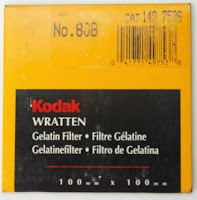
My dad was a local pharmacist and contracted with a camera shop down on Falls Road to provide film developing service for his customers. He was supportive of my hobby (so long as I didn't get the foolish idea that I could make a living looking at stars) and helped me to get a 2x2"Wratten 80A blue gelatin sheet and a mounting ring for the filter that was just a little smaller than the internal diameter of the refractor's dew shield. I carefully cut out my circle of blue, mounted it in the holder, dropped it into the front end of the scope and then waited for the next clear night. 

The view of Jupiter was quite pretty with its blue hue, but even after several attempts on different nights I still could see no GRS. (Of course, I am assuming that just by the odds I would have seen it on one of those evenings. I had not discovered Sky & Telescope with its listing of GRS transits yet, and online lookup would have been the glorious stuff of science fiction in the mid-60s). While filters lost a little of their charm from the experience, I felt that the principle was certainly sound. Reddish features would have their light blocked by a complementary blue filter, making them darker and easier to see. I began to suspect (correctly) that it was more an issue of small aperture than filter failure.

When I graduated to my 6" Newtonian I was finally able to catch sight of the Great Red Spot one evening without a filter. It had fairly good intensity back in the late 60's - similar to its appearance now. The availability of a glass filter that would screw into the bottom of the eyepiece was (as far as I knew) nonexistent. So no filters for visual inspection of my planetary quarry at that point in time.

But by now I was starting to play with using a second-hand Minolta range-finder camera to take pictures using the afocal method. Talk about a tedious hit or miss approach! You had to line up the camera over the eyepiece at where you think you are at focus, then hopefully get the planet in the field just based on the 6x30 finder scope, and finally snap the picture with a cable release while hopefully not jiggling the scope. Despite all that, I had occasional success with the technique. It also drove me to learn how to do my own B&W development rather than watch the photo lab assume nothing was on the roll of film and slice right through my field when trimming the negatives.

By this point I'm a HS freshman, networking with fellow amateurs at the Baltimore Astronomical Society and with enough pocket money from working at the pharmacy to buy some hobby stuff. I got another filter holder that would attach to the front of the Minolta and outfitted it with a Wratten blue gelatin. And then on a May evening in 1970 I did it - I actually captured the GRS photographically, a dark spot near the planet's central meridian. It was an OMG!! moment as I inspected that roll of film while hanging it up to dry. 
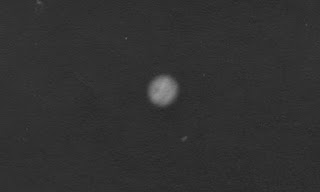
Jupiter - afocal method with 6" f/8 RV-6 at 140x
using Minolta camera with 80A filter

It was probably shortly after this that I began to find retailers of glass Wratten filters that we are so familiar with today. I started my collection with a #80A blue and it gradually expanded like a rainbow. Over the years I have found that, for visual planetary observing, they are not going the wow you like an O-III filter can do on an emission nebula. But they can be helpful if you approach their potential realistically, i.e., a tool that can improve the contrast of notoriously low-contrast planetary features. In addition, they do not cost an arm and a leg (at least not for the basic Wratten glass filters that almost any good astronomical supply house will carry).

Although I am given over more to imaging a planet rather than sketching it these days, I still do enjoy at the end of the session taking a few minutes to gaze upon my target before putting away the equipment. In doing so I'll almost always apply a filter in an effort to see the most that I can. Here are my common go-to filters using my 10" reflector (if you have a smaller scope then a corresponding filter with higher transmission rate may be a better fit):

The brilliance of our sister planet Venus means you have to knock down the glare significantly to be able to appreciate the disk. I often use a #47 Violet with only 13% transmission to accomplish that. The most I have been able to make out on Venus is some brightening at one or both polar regions ("cusp caps").

When Mars comes calling every other year it is a fun target and arguably one of the best for filter enhancement. The #80A medium blue is helpful in seeing the polar ice caps and lighter orthographic clouds that sometimes form. A light red #23A helps to darken the albedo features and boost their contrast. I have also found a deep yellow #15 to be a nice choice to reduce the planet's brightness and boost overall contrast.

Mars through my 6" f/8 RV-6 & Red #23A filter 10/7/2020


Jupiter is an absolute favorite for me given how dynamic it is. I have always found a yellow filter (#15 deep yellow or #11 yellow) as a good, all purpose aid to improving the contrast of the belts against the lighter zones. A pale blue (#82A) or medium blue (#80A) are helpful as well, especially with the Great Red Spot (the pale blue improves the contrast yet you can still pick out some of the red overtones to it).

While not as subtle as features among Venusian cloud tops, Saturn offers delicate features with its gradually darkening belts as you move from bright equatorial zone to dark polar hexagon. Again, a yellow filter seems to work well for improving the contrast a bit on the globe. 

Based on a very interesting "consumer reports" article on Cloudy Nights where author William A. Paolini compared multiple filters to find the ones that seemed to be the best for accentuating planetary detail, I have recently purchased a Baader Contrast-Booster filter. Now I just need to wait for this fall when we'll have Mars, Jupiter, and Saturn available for my own assessment of how well it does. 

If planetary observation is something you enjoy then you really should play around with some filters to see if they help you pick out some of the subtler details. Most retailers offer the Wratten color filters for under $20, and so long as you are not expecting miracles to happen, you'll likely find them an interesting and enjoyable accessory to have in your observing armamentarium. 

Friday, December 11, 2020

Special Occasions

The science writers are at it again, hawking the "Grand Conjunction" of Saturn and Jupiter that will take place on December 21, 2020 as a bright Christmas Star for all to see. On that evening the two planets will be a scant 0.1° apart, close enough that they should both comfortably fit into most amateur telescopes at low to medium power. It is clearly a special occasion since the last time these two giants were visible this close together in the night sky was 1226 when St. Francis of Assisi was around. Of course there's also the fringe media that is having a ball with it, claiming this alignment at Winter solstice is a bad omen (just search for "grand conjunction 2020 predictions").

Hype aside, amateur astronomers are indeed excited to witness this alignment. Roughly every twenty years Jupiter catches up with Saturn, pairing up with it in the heavens. In 1980 and 2000 they got to within about 1¼° of each other, and will do so again in 2040. But the 2000 and 2040 alignments suffer from Sun glare, making the spectacle hard or impossible to appreciate. The spring of 2060 should deliver a mega hit to any conjunction junkie with Jupiter and Saturn getting within about 1 degree of each other amid Taurus while Venus threads her way through the Pleiades and a crescent Moon thrown in for good measure on the night of April 4th!

Saturn-Jupiter-Venus Conjunction
Grand Conjunction of 2060


So, looking at that Stellarium Online image of the conjunction on the night of April 4th in 2060, did you get excited? Did you think, "Wow, don't want to miss that!" (assuming you're under 40)? What is it about these gatherings of celestial orbs that makes the amateur astronomer circle the date on their calendar in expectation?

I think some of it relates to the yin-yang aspect of our hobby. On the one side we have the "passive" sense of the heavens. They are consistent, steady, predictable. There is something almost reassuring seeing Orion raise up from his side on a late October evening. We know that almost nothing of shallow or deep space has altered much since Galileo's first scope or Messier's compilation of faux comets. When I say "Albireo" your mind's eye brings forth a beautiful double star. Like travelers who've embarked on a country wide road trip to see the sights, we revel in comparing notes and swapping photos of the cool things we've visited. 

And then there's the "active" side of the night sky. Here we seek to catch ephemeral sights that may be constrained by location or good fortune. You venture out under cold, clear December skies on the 12th in hopes of catching a Geminid that is spectacular. We trek across country or even across continents in hopes of catching a few minutes of the solar corona. These two examples categorize the action; some of it is somewhat random (meteor showers, super novae, sunspots, aurora) while others are anticipated. 

Most of that predictable action centers around alignments. Conjunctions, eclipses, occultations, transits - all provide opportunities to experience something that ranges from uncommon to very rare. And while we have the sublime beauty of Saturn's rings or wispy tendril's of Orion's sword available to us on any clear night when they lie above the horizon, the beauty of a celestial alignment is often brief and may not be repeated in your lifetime. I doubt I shall ever see another Mercury transit but hope to work in another total eclipse.

Thankfully the universe is like a top chef at a 5 star restaurant, continually serving up one delightful alignment dish after another. In spring we had the octennial passage of Venus through the Pleiades, in fall we had a generational opposition of Mars. And now we get something even more uncommon, a "grand conjunction" of Jupiter and Saturn to close out a rather tedious year. So go out there and try to see it, photograph it, soak it in as yet another special occasion brought to you courtesy of the universe!

Jupiter & Saturn Dec 8, 2020
Jupiter & Saturn Drawing Together on Dec 8, 2020
