Showing posts with label Conjunction. Show all posts

Sunday, September 28, 2025

A Regal Conjunction

On September 19, 2025, a rare celestial event unfolded in the pre-dawn skies over Maryland: the conjunction of the Moon, Venus, and Regulus. I had high anticipation for this conjunction for several reasons. First, the tight grouping of the three celestial bodies was remarkable. Venus, the waning crescent Moon, and Regulus (Leo the Lion’s lucida) were packed within a 1-degree field of view. This meant that they were close enough to fit under a fingertip held at arm’s length, or easily with my telephoto lens racked out to 300mm.

So often the word “rare” is thrown about with abandon in regard to astronomical events. But this one does merit the appellation. A similarly tight grouping won’t occur again until September 22, 2041, when the trio will fit within a 7.2° circle. My research could not find any evidence of another triple conjunction from Maryland that will fit within a 1.0° field of view for at least the next 50 years.

Preparation

A few days out, the weather forecast looked very favorable for the morning of September 19th, so I set about planning for it. I jumped on the Heavens-Above website and used their interactive sky chart and twilight times to get a preview. Those tools let me know that the event would be low on my eastern horizon, which was a problem due to the trees and houses that blocked my eastern view from home.

I needed a better venue and thought that somewhere along the nearby Loch Raven Reservoir might offer a clearer eastern horizon. I ruled out any trails as it could be risky navigating an unfamiliar path in the dark while carrying my camera equipment. Exploring virtually with Google maps, I noticed several small “observation decks” along the eastern side of the Dulaney Valley road bridge that crosses the reservoir. By midweek I had a game plan: park my car off on the shoulder near the bridge and walk a quarter mile to the platform.

The day before the conjunction, I weighed doing a reconnaissance of the bridge, anticipating that I would swing by right after work around 3:30 p.m. However, fate had other plans. Around 10 a.m., I received news that I was being laid off as part of budget cuts and had to hand in my laptop by 2 p.m. Given that 2026 was going to be my last year of part-time work as an OCR software developer, the layoff was not a significant impact, although there was the emotional aspect of no longer being employed after over half a century of work. The immediate upside was that it gave me an early departure time to head out to the reservoir. My drive out to the bridge validated my plans to park the car just before the bridge and walk out to the first fishing platform.

The Conjunction

I set my alarm for 4:30 a.m. Thursday evening, but I was up before the alarm went off. I dressed quickly and hustled out the door with my camera. I was at the pull-off area south of the bridge within a few minutes, parking the car and gathering my equipment. As I used my cell phone’s torch to light the path out to the platform, I pushed away the slight anxiety that creeps in, that sense of caution mixed with danger when doing something like this.

As I rounded the corner and stepped onto the bridge I saw my prize: an ocher-colored Moon rising, with Venus hanging just below it, both attenuated by the atmosphere. Regulus was not visible at that point, either hiding behind the trees or extinguished by the horizon haze. I was a bit surprised to see the Moon was in front of me rather than to my right over the water. As I advanced towards the bridge, the tree line slowly loomed taller and taller. By the time I was at the platform, the Moon and Venus were just skirting the treetops on the opposite shore. While not the imagined view of Moon rising over the waters of the reservoir, the setting was certainly beautiful.

The Crescent Moon & Venus

I set up the camera and bracketed a few shots of the slender orange crescent juxtaposed with a cream-colored Venus dangling below it. Time passed quickly, and as the duo climbed out of the haze, I could soon see Regulus hanging below Venus, forming a remarkable straight line. The earthshine was now evident, adding to the sublime nature of the appulse. For the next 45 minutes, I captured images at various focal lengths and exposures. Even at the full 300mm of the telephoto lens, all three members of the conjunction were in the frame due to the tightness of the conjunction. I knew the more challenging aspect in replicating with the camera what my eyes were witnessing would be the brightness contrast of these three. Venus outshone Regulus by about 100 times, while the Moon was just 5–6% illuminated, creating a dramatic visual contrast that our logarithmic eyes can handle well but pixels struggle to faithfully reproduce. Some things are just seemingly made for naked eye observation.

Moon, Venus, Regulus (and earthshine)

I had to contend with the southbound traffic coming from Jarrettsville Pike, timing my shots to miss their oncoming headlights intruding into my frame, even with the lens hood attached. I also noted that at times when some vehicles passed by on the bridge, there was some vibration, which likely ruined some shots. After about an hour and with dawn beginning to lighten the horizon, I packed up the camera and began the trip back home.

Conjunction reflected in the water below
As I pulled up in front of my house around 6:20 a.m., I assessed where the Moon was. It was still hidden behind trees, so I walked around to the backyard, camera and tripod in hand. It was not until I moved to the farthest southwest corner of the yard that the trio of conjunction companions cleared the rooftops. I fired off a couple of shots as the eastern sky gradually grew brighter, concluding my engagement with this magnificent conjunction by about 6:30 a.m.

The conjunction from my backyard

Witnessing this triple conjunction of the Moon, Venus, and Regulus was absolutely an unforgettable experience. The planning, the anticipation, and the sheer beauty of the event made it a night to remember, and the images will serve as a wonderful reminder of that September morning out at Loch Raven as the heavens aligned.

Friday, June 16, 2023

Hanging Out in the Crib

Amateur astronomy has a bit of a reputation for needing significant and sophisticated equipment to enjoy. And if you are looking to target faint objects, or dive into photography, well then there is certainly some truth to that. But the universe has so much to offer, and some of those items really do not need much more than a nice venue and a pair of binoculars (or your eyes) to touch your soul.

One such type of event is an appulse1, "an approach between two celestial bodies." As the Moon makes its monthly trek along the ecliptic it will often pair with one of the brighter planets. Due to the various inclinations of their orbits to the ecliptic sometimes we have wide space between the two, or on rarer occasion the Moon will cover up (occult) the object for a period of time. There are also four 1st magnitude stars that lie sufficiently close to the ecliptic that they can sometimes be visited in the sky by one of the denizens of our solar system. I'll leave it as a research project for those interested in identifying them if you're not familiar with that quartet.

A little more subtle (unless, perhaps, you are in very dark skies) are the three open clusters that lie close enough to the ecliptic to also host one of the planets. Interestingly, these all lie in the Winter Zodiac. The Pleaides is the brightest and most spectacular of the trio. It also lies the farthest off the ecliptic at 4° and so will have infrequent visitors. Every 8 years Venus drops by for a visit to the Seven Sisters, making for a beautiful alignment. 

Venus Amid Pleaides

While M35 in Gemini does not have a catchy moniker, it does own the inside post position to the ecliptic, lying only 52 arc-minutes away. As a result it is more common to see interlopers jog by it, especially Jupiter which has a low inclination to the ecliptic and so unable to stray far from it. It is also noteworthy that M35 comes very close to the point in the heavens where the Sun reaches its greatest northern culmination (i.e., the Summer Solstice) - a conjunction that we can never observe unless there were a Total Solar Eclipse in progress. Talk about your rare event!

The Sumer Solstice - June 21, 2023 11am EDT

Finally we have M44, the "Beehive" cluster in Cancer. A little more than a degree off the ecliptic it also is in position to allow the occasional planetary orb to join its aviary for a night or two. While not as dense or showy as the other two clusters, it is still easily visible to the naked eye from dark skies and was known in antiquity as Praesepe (the "crib"). Sailors used it as a barometer since if it was hidden from view by a veil of thin cirrus clouds then overcast skies and possibly rain was in store for the next day.

All spring there has been a celestial chase between the Goddess of Love and the God of War unfolding in the evening twilight. Venus has been gaining on the Red planet, pursuing him through Taurus, Gemini, and now Cancer. In early June Mars attempted to hide himself among the stars of M44 for a couple of days while Venus drew near to Castor and Pollux to seemingly inquire as to his whereabouts. The dual appulses were beautiful and could be appreciated by one's eyes or simple binoculars. I happened to be at South Bethany in Delaware visiting my sister those evenings, and sitting out back along the canal watching the scene emerge as darkness fell was simple & sublime. 


While I couldn't take my scope, my Canon camera and a tripod were easy to bring and allowed me to create my own postcard souvenir of the trip. Taking a series of 10-sec shots at 18mm captured all the players on stage, and then as darkness fell a set of 3-sec shots at 55mm allowed Mars to have the spotlight as a ruby set amid the glittering bees. Simple processing in freeware such as Deep Sky Stacker and Sequator produced wonderful results with additional enhancement in Photoshop.

Appulses and other simple pleasures of the night sky are encountered multiple times a year. Don't overlook the opportunity they provide to sit back and drink in the profound majesty of the heavens in an uncomplicated way.

1 This is basically another term for a conjunction


Sunday, January 9, 2022

Lunchtime Venus

Since late last spring Venus has been an evening star in our skies, shining brilliantly in the southwest. It was not the best of apparitions for those of us at mid-northern latitudes as it hung out in the basement of the zodiac when reaching its greatest distance from the Sun. I only managed a couple of casual observations and a single imaging attempt due to the planet often being obstructed by trees or buildings from my home observing venue.

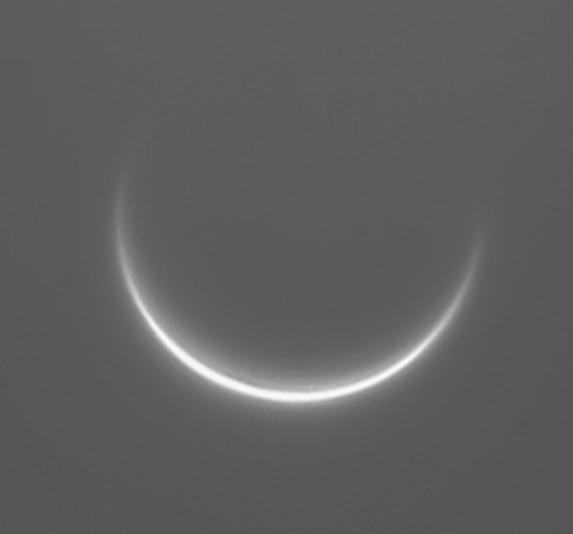
Like all evening appearances of our sister planet, the transition from evening to morning star is defined by Venus reaching "inferior conjunction." This event, where the planet passes between Earth and the Sun, was set to occur on Saturday, January 8th around 7:40 p.m. our time. If the Earth-Venus-Sun orbital alignment were straight on we would witness Venus transiting the face of our home star at each one of these passages. But, just as we are not treated to a solar eclipse at every new Moon, Venus' orbital inclination of 3° to the ecliptic causes her to glide north or south of the Sun. Only roughly once a century do we get to witness a pair of transits, spaced eight years apart, with the most recent taking place in June of 2012.

This weekend's conjunction saw Venus skirting Sol's northern limb by about 4.5°, leading most websites such as In the Sky to state

At closest approach, Venus will appear at a separation of only 4°51' from the Sun, making it totally unobservable for several weeks while it is lost in the Sun's glare.

S&T Image Credit

In actuality, to describe it as totally unobservable is perhaps a bit of an exaggeration. It's one of those observing challenges that can be done, albeit with great care since even a brief exposure to the Sun's surface through any sort of optical aid can easily damage your retina. I've viewed Venus in the daytime before, both naked eye and with telescope, on numerous occasions, but had never attempted an Inferior Conjunction sighting. With the forecast for conjunction day looking quite good I decided to take up this challenge.

My hope was to actually get an image of the event, so I arose before dawn to mount the 6" reflector and perform an alignment. After battling some passing clouds I finally got the Celestron mount able to slew to a target with reasonable accuracy. I left the drive running and waited for my quarry to rise high enough in the eastern sky to view it. 

By 10:30 a.m. the winter Sun was well placed so I attached the camera and asked the mount to center Venus. I had placed a red filter in the optical path to help boost contrast against the bright blue sky, but the screen was still a bright, featureless canvas. I tried slowly sweeping the area a little bit to no avail. I finally removed the camera and substituted a 16mm eyepiece to see if I could make a visual sighting, but that, too, ended in failure. I reluctantly broke down the equipment and headed inside.

Not quite willing to accept defeat, while eating lunch I plotted my next attack. I considered that Venus should be positioned pretty much at the 12 o'clock position relative to the Sun's disk at this time. What if I positioned myself such that the apex of the neighbor's house blocked old Sol? Would that allow me catch Venus in the sky above the roofline with binoculars? I grabbed my trusty 7x50 Celestron binoculars and headed outside to find out. I swept the area until my arms grew tired with still no sign of the planet. As a last ditch effort I brought out the 15x70 Oberwerk binoculars to see if they might do the trick. After about five minutes - there!! A surprisingly bright, tiny crescent lying on its back was visible above the rooftop. It was a little surprising how clear one could distinguish the crescent shape and how white, like snow, the disk seemed in the blue sky. 

I hurried inside to grab the Canon and telephoto lens in hopes of capturing a shot using the same technique. When I emerged and used the Oberwerks to try to relocate Venus I struggled. Where the heck was it - I had just seen the darn thing. Then fate lent a hand when a jet billowing a contrail behind it crossed the field. Within a few seconds I had identified Venus again. Once the contrail had dissipated, it was again tough to pick out the tiny crescent. A few minutes later another jet deposited its white contrail in the vicinity, and again it became easier to pick up Venus in the field. Thinking about this I suspect that as the field jostled from my unsteady hand the planet moved with the contrail, thus becoming more apparent to my brain. Whatever the actual reason it was an undisputed truth that having the contrail in the field made picking up the planet easier.

In yet another testimony to our eyes' logarithmic response to light, the photos appear to have been a bust as well since exposures long enough to possibly pick up Venus were overexposed. The result is in a field containing a wide range of light intensities, our eyes will provide a good image whereas it is often impossible for the camera to capture it. And although I may have come away with no photographic proof of my success, the experience adds another page in my book of  amateur astronomy that I will have fond memories of.

A digital sketch of Venus & Contrail


Friday, December 11, 2020

Special Occasions

The science writers are at it again, hawking the "Grand Conjunction" of Saturn and Jupiter that will take place on December 21, 2020 as a bright Christmas Star for all to see. On that evening the two planets will be a scant 0.1° apart, close enough that they should both comfortably fit into most amateur telescopes at low to medium power. It is clearly a special occasion since the last time these two giants were visible this close together in the night sky was 1226 when St. Francis of Assisi was around. Of course there's also the fringe media that is having a ball with it, claiming this alignment at Winter solstice is a bad omen (just search for "grand conjunction 2020 predictions").

Hype aside, amateur astronomers are indeed excited to witness this alignment. Roughly every twenty years Jupiter catches up with Saturn, pairing up with it in the heavens. In 1980 and 2000 they got to within about 1¼° of each other, and will do so again in 2040. But the 2000 and 2040 alignments suffer from Sun glare, making the spectacle hard or impossible to appreciate. The spring of 2060 should deliver a mega hit to any conjunction junkie with Jupiter and Saturn getting within about 1 degree of each other amid Taurus while Venus threads her way through the Pleiades and a crescent Moon thrown in for good measure on the night of April 4th!

Saturn-Jupiter-Venus Conjunction
Grand Conjunction of 2060


So, looking at that Stellarium Online image of the conjunction on the night of April 4th in 2060, did you get excited? Did you think, "Wow, don't want to miss that!" (assuming you're under 40)? What is it about these gatherings of celestial orbs that makes the amateur astronomer circle the date on their calendar in expectation?

I think some of it relates to the yin-yang aspect of our hobby. On the one side we have the "passive" sense of the heavens. They are consistent, steady, predictable. There is something almost reassuring seeing Orion raise up from his side on a late October evening. We know that almost nothing of shallow or deep space has altered much since Galileo's first scope or Messier's compilation of faux comets. When I say "Albireo" your mind's eye brings forth a beautiful double star. Like travelers who've embarked on a country wide road trip to see the sights, we revel in comparing notes and swapping photos of the cool things we've visited. 

And then there's the "active" side of the night sky. Here we seek to catch ephemeral sights that may be constrained by location or good fortune. You venture out under cold, clear December skies on the 12th in hopes of catching a Geminid that is spectacular. We trek across country or even across continents in hopes of catching a few minutes of the solar corona. These two examples categorize the action; some of it is somewhat random (meteor showers, super novae, sunspots, aurora) while others are anticipated. 

Most of that predictable action centers around alignments. Conjunctions, eclipses, occultations, transits - all provide opportunities to experience something that ranges from uncommon to very rare. And while we have the sublime beauty of Saturn's rings or wispy tendril's of Orion's sword available to us on any clear night when they lie above the horizon, the beauty of a celestial alignment is often brief and may not be repeated in your lifetime. I doubt I shall ever see another Mercury transit but hope to work in another total eclipse.

Thankfully the universe is like a top chef at a 5 star restaurant, continually serving up one delightful alignment dish after another. In spring we had the octennial passage of Venus through the Pleiades, in fall we had a generational opposition of Mars. And now we get something even more uncommon, a "grand conjunction" of Jupiter and Saturn to close out a rather tedious year. So go out there and try to see it, photograph it, soak it in as yet another special occasion brought to you courtesy of the universe!

Jupiter & Saturn Dec 8, 2020
Jupiter & Saturn Drawing Together on Dec 8, 2020

Thursday, April 16, 2020

The Venus Show

One thing is for certain - the disruption of our routines thanks to the COVID-19 virus outbreak has created a vacuum. Binge-watching has taken center stage for a lot of America, but if you step outside you'll find another show streaming through the evening twilight. Venus has been dazzling, high above the horizon like a super intense LED. Even the average person out for their stroll around the neighborhood notices this gem in the western sky.

Our sister planet returned to the evening twilight last fall. I recall catching sight of her in early November heading south on I-81 in Virginia on our way to NC, anchoring a wonderful Zodiacal alignment of Venus-Jupiter-Saturn. Slowly but steadily since then, like a diver ascending the ladder to the high dive platform, Venus has been gaining altitude from the Sun's glare.

Venus and crescent Moon Thanksgiving evening 2019


This evening apparition has been particularly auspicious, hitting a trifecta + one of favorable celestial mechanics. First, for us spring brings the angle of the ecliptic - that imaginary highway that the visible planets traverse - to its steepest angle with the horizon, reaching 73° on March 24th. This means that every degree that a planet lies from the Sun translates to maximum distance above our northern hemisphere horizon.

Next, that date of steepest ecliptic coincided with Venus reaching the point in its orbit where it forms a right angle alignment between itself, the Sun, and us - i.e., the greatest distance it can appear separated from our home star. The result of all this? Our brilliant neighbor began the evenings in late March a full 44° above the horizon, an inner-planet party animal that stayed up until close to midnight.

Another favorable aspect is that on March 20th the planet was at perihelion - the point in its orbit where it lies closest to the Sun. This contributes slightly to the planet's brightness so that when it hits that sweet spot between disk size and phase on April 28th it achieves an eye-catching maximum brilliance of -4.4 magnitude. While it may not be visually apparent that Venus is reaching an incremental notch above its normal brilliance it is as good as it gets (but don't tell the press less we start a "Super Venus!" meme). 

Perhaps the pièce de résistance of this apparition was Venus making a call upon the Pleiades, passing through their midst on April 3rd. While not rare (it happens every 8 years due to celestial mechanics returning Venus to roughly the same spot) it is one of the most lovely and photogenic conjunctions around. I have (somewhere) a shot of a similar alignment some 24 years ago taken on film. This time around I used the digital magic of taking 200+ shots with my 200mm lens and stacking them to produce a nice souvenir of the occasion (star spikes courtesy of Photoshop).

M45 and Venus on Apr 2, 2020
 
But wait - there's more! Like that diver perched high above on the platform our sister planet is preparing to swan dive into the glare of the Sun. Once we reach dichotomy (half phase) Venus becomes a more interesting target for amateur astronomers with even a modest scope. We enter a period where the size and apparent phase alter week by week and then day by day as we approach the June 3rd inferior conjunction date. If you have never tried to spot Venus in the daytime you'll have a great opportunity on April 26th using the Moon as your guide as it slides roughly 5° south of the planet. It also is a great time to see how soon you can pick out the phase using only binoculars or capture it using only your telephoto lens.

Remember, you don't have to practice social distancing with your old friends in the night sky - let them infect you with their beauty and mystery!


Thursday, January 31, 2019

Fabulous But Frosty

Well January 2019 is just about in the record books - and it was both kind and cruel to my observation quests. The "big events" that I was interested in were the lunar eclipse on January 20th and the Venus-Jupiter-Luna alignment at month's end. It was kind in that the skies were indeed clear - but cruel in terms of the deep freeze one had to endure to witness them!


It seemed doubtful for a while that those of us in the mid-Atlantic would see the eclipse thanks to "Winter Storm Harper". (Seriously - we need names for these now? Apparently the NWS does not go along with the idea which is the brain child of the Weather Channel - you know, the folks who stand out there bringing you live coverage of catastrophic weather events, like this. But I digress with my disdain for hype). I happened to be a little NW of Baltimore at my son's in Waynesboro PA, and by the time Sunday rolled around it looked like it would be clear - but also bitterly cold and windy. It was too much to pack the scope but I figured the camera & tripod was worth a go.

I took a couple shots around 8pm through some high, thin clouds and then decided I'd just rest a bit after a busy day with my grandson. I startled awake at about 10:40 p.m. just in time to see the Earth's shadow having nibbled away at the Moon's edge. I could last about 5 minutes or so of taking shots before retreating into the home to warm up, leaving the camera outside tucked up against the house. Even with the tripod the wind ruined probably a third of my shots.

An overexposed eclipsed Moon with M44 to left

Just as totality began the battery on the camera signaled it was about done, further testimony to how cold it was. I brought it inside to change it out and as expected the lens immediately dewed over. I left it near a warm spot and popped on the wide field lens. It's definitely darker up in Waynesboro so I was fairly happy with the shots where I tried to include some of the fainter stars and the famous Beehive cluster. Then with the telephoto warmed up and ready for action again I swapped out lenses again and took some of the eclipsed Moon. I have not seen any official reports (or unofficial for that matter) but to me this was a fairly dark eclipse - perhaps a 2 on the Danjon scale as the deepest part of the shadow was grayer than the usual deep orange.

A rather dark eclipse?

By a little after 1 a.m. I abandoned any thoughts of eclipse egress photography - my grandson would be up in about 5 hours and I needed to be functional 😴

The second celestial highlight was the aforementioned appulse of Moon, Venus, and Jupiter. For several weeks I've admired the dance of Jupiter and Venus as old Jove slowly emerged from twilight to reach and then overtake the dazzling Venus. Those early morning January skies with the pair amid the stars of Scorpio were gorgeous - the combination of the winter transparency and the fewer lights made me literally stop and linger for a minute or two before climbing into the car to head off to work.

Venus & Jupiter mid-January


So with the waning crescent joining it was was time to grab the camera once more. But mother nature once again exacted a cold price with another Polar Vortex descending upon us (I'll let that piece of WC fluff slide...). Although technically colder than eclipse night the winds were not nearly as bad. That being said, it was a brief session admiring the alignment and grabbing a few quick shots before heading down the road.

So all in all January worked out just fine. After all, you can do something to fight off the cold, but with overcast skies you're just outta luck!


Venus - Moon - Jupiter January 31, 2019


Saturday, July 4, 2015

A Celestial Pairing

The media was abuzz the last week with the close conjunction of Venus and Jupiter in the western sky. It really was eye-catching, the two brightest planets coming so close together. Of course the media in its subtle secular way promoted this as a recreation of the Star of Bethlehem. But let's not digress...
The closest approach was on Tuesday evening. The mid-Atlantic has had a very rainy June - wettest month of June on record as a matter of fact. So the pattern has been clouds and more clouds, making for scant opportunity to follow the two planets drawing closer and closer. On Tuesday the skies to the west were pretty hazy, and the planetary pair were just able to pierce the shroud to be captured. At least I could say I saw it!
Venus (lower) and Jupiter June 30th
The next night was a bit better - not a wonderfully transparent sky but certainly clearer than a normal evening we've had lately. I got the camera onto the tripod and headed outside. The pair had grown perceptibly apart and had shifted into a side-by-side alignment, but still close to one another. I took my first dozen shots (that is so nice about a digital camera, immediate feedback and no worries about a cost associated with each camera click) when suddenly it stopped working! I quickly saw the issue - no space left on the card. Quick dash inside to load a new card and I was back in action.
Over the period of about 40 minutes I grabbed about 50 shots. One somewhat frustrating thing was that the part of the sky where they glistened must be a flight path - I had more than one shot polluted by a plane intruding into it - but nothing a little digital slight of hand won't be able to erase since the exposures were pretty short. Below is the shot that for me will go into the scrapbook when I want to remember this appulse. (Click for full view)
Venus and Jupiter July 1, 2015 10pm
Canon Ti3 18mm f/3.5 4 sec exposure

Monday, August 18, 2014

A Pre-dawn Planetary Appulse

The weather gods were kind and granted clear skies over Towson this morning, affording me an opportunity to grab a peek at the close pairing of Jupiter and Venus (at 5 a.m. ET this morning they were roughly a third of a degree apart, less than the appearance of a full moon). While not as rare as a Venus transit like we had in 2012, these two planetary beacons coming so close is not a common occurrence. And it is always eye-catching to say the least!
I decided to not set an alarm, trusting that I normally turn over an hour or so before sunrise anyway (perhaps a bit too trusting, but it panned out as expected). Grabbing the charged camera and tripod I headed out the front door around 5:30 to look for our duo. Unfortunately the eastern skyline in front of my home is not a great spot for horizon hugging events. So into the car with hopes of quickly locating a suitable venue with perhaps an interesting backdrop for a few shots. As I started up the hill I was continually making furtive glances to the east, and then I caught sight of them at the tree line as I passed the Towson Presbyterian Home. I circled the block and hopped out to see if I could compose a nice shot, opting for one with them nestled amid a dip in the treeline.
The first exposure at about 15 seconds was way too bright (the 'instant feedback' of a digital camera is really nice for catching such a problem quickly), so I shortened the exposure until I could see the two dots on the LCD screen. Bracketing around that ~2 second exposure at ASA 800 I collected several shots. With those secured I ambled about the front lawn in search for another interesting composition. I made two more series of photos for the raising pair, but the increasingly bright sky as dawn inexorably proceeded meant my first shots were probably the best. By 6 a.m. it was all over, barely ten minutes of snapping photos.
The best of the shots is above - played with it a bit in Paintshop to darken the sky and boost the contrast. May post some more after I have a chance to play with the images