Showing posts with label Mars. Show all posts

Thursday, January 30, 2025

Chasing Planets: January's Observations and Challenges

The media has been hawking the auspicious "planetary parade" that allows an observer to see 6 planets during frosty January evenings. Of course two of those (Uranus and Neptune) are not naked eye objects. I do not mind articles that generate interest in our hobby, but my fear is always the "over promising and under deliver" risk.

However, January was indeed a fun month for us planet observers. Mars was occulted by the nearly Full Moon on the evening of the 13th, and then two days later came to opposition for this apparition. Jupiter was positioned well and decided to throw a major eruption amid its North Tropical Zone southern jet stream on January 10th, garnering a lot of attention. Venus also ascended the Zodiac after lying close to the southwestern horizon most of its current evening apparition, reaching greatest elongation on the 10th heading for its highest altitude in the western sky on February 2nd. The only downside has been the weather with classic winter turbulent seeing amid very cold temps.

Mars Occultation

The skies were clear but quite cold for the occultation of Mars. I set up the 10" Cyrus telescope and verified its collimation. The Moon served as a convenient focus target as I set up about 20 minutes before the scheduled disappearance. I knew that the difference in brightness would be a challenge and thought I'd have time to fiddle with the gain setting right before the occultation, but it happened so fast that I really did not get a great capture with the Moon very overexposed. Still, it was a very cool event to watch the Moon relentlessly approach the red orb and cover it up with about 30 seconds.

The Moon ready to cover Mars

January 17th Session

The evening of the 17th was predicted to have average seeing and temperature right around the freezing mark, which is fairly good for this region in winter. I again set the Cyrus scope out early to cool and verified its collimation. As Venus emerged from encroaching twilight I set to work on capturing our sister planet. 

Starting with the Deep Red filter (642+nm) and no Barlow, Venus provided a bright target upon which to focus. Doing a 5 minute capture resulted in a nice image, showing the planet past dichotomy and a common cue-ball appearance. I have yet to truly discern any cloud details in IR light.


Swapping out the Deep Red filter for an IR-block and UV set, I retargeted the planet and adjusted the settings to bring up the brightness in the fainter UV light. I could make out even on the on-screen image that there was uneven brightness in the sunlight reflecting off the Venusian cloud tops.

Processing produced a nice greyscale image with a some cloud structure. Interestingly, a well defined cusp cap was not really seen, although you might argue one was around the south pole region. This is somewhat in agreement with the UV Venus images I have been seeing submitted to the ALPO for the current evening apparition; cusp caps are not as prominent as I believe they were during the last apparition.

By now Saturn was visible in the deepening twilight, close and to the left of Venus. I figured why not give it one last capture since the upcoming mid-March solar conjunction and my obstructed western horizon meant it would soon be inaccessible. I added the Barlow back into the imaging path and returned to the Deep Red filter. Seeing was not very good, and the rings had closed up again compared to a few months ago. I had enough juice in the laptop for two 2-minute captures, resulting in a sub-par image where it is hard to even detect the globe's shadow being cast against the rings. Au revoir Saturn - until we meet again in the late spring!

Getting the AC adapter hooked up to the laptop I next swung over to Jupiter. My hopes were to get multiple captures into the evening if the weather held, recording not only the very recent North Tropical Zone southern jet stream eruption but also that continually expanding disturbance in the South Equatorial Belt that started back in November.

The seeing ended up being fairly good over the course of about 5 hours, allowing me to capture a lot of interesting features, including that NTrZ outbreak. As we began to close in on midnight the gods conspired to end my run as the cirrus clouds began to thicken and the tracking on the Celestron mount suddenly had a stall (it is always amazing how quickly the planet exits the frame when this happens). Rather than fight to recenter and continue amid the deteriorating seeing and transparency I decided to wrap things up on Jupiter.
In the middle of my Jupiter captures I had to take a break due to the location of the planet. When an object is high and near the meridian, the Cyrus telescope tube runs up against one of the tripod legs. The resolution would be to raise the tube up off the saddle, somewhat like extending with a pier. But that would be a lot of effort and so is not likely to happen in the near future (if at all). 
But rather than waste the time I opted to do a run on Mars which had just passed opposition a few days earlier. While at only about 13" in size the disk was large enough to take in some nice albedo features such as Syrtis Major setting and Sinus Sabaeus and Sinus Meridiani on the central meridian. The NPC was also a brilliant white and was a good feature to leverage in trying to get the best possible focus. Hopefully I will get in a few more sessions with Mars for this apparition, but it's going to shrink in size quickly now that it is past opposition.
While I did not achieve all my goals for the evening (I missed seeing the SEB disturbance on Jupiter), it was quite a good night for the middle of January. It reflects why planetary observing provides such a rich experience for the amateur astronomer.


Monday, December 30, 2024

December Planet Parade

While it is nice to see a planet coming to opposition in the northern part of the zodiac given the much higher altitude it then attains in our skies. But while the planet heads north, our opportunities of good seeing go south. The heat of the day radiating into the atmosphere sets up turbulence and often results in poor seeing. It also seems that the winter months are more overcast. This year I went 51 days (late October to mid-December) between observations - not great! 

Uranus - December 18, 2024

At the start of the year one of the astronomy goals I had set was to image Uranus with its moons. I tried a couple of times earlier in the fall without success, but finally on the night of the 18th I got the SharpCap stacking working with Uranus as the target. I had to keep the region of interest (RoI) wide because otherwise the software complained of not having enough stars to align. I played with the exposure and gain to finally generate a nice stacked image that clearly showed some of the moons.


Using some post-processing tools to enhance the raw stack resulted in a fairly satisfying result. The Sky & Telescope online tool that shows where the moons are in relation to the planet was helpful in orienting the shot. I ended up capturing 4 of them (Titania, Oberon, Ariel, and Umbriel) - Miranda was probably lost in the glare of the planet. Maybe next time I'll try to include the Barlow in the imaging train to gain some more space between the planet and moon.

After that success I decided to focus on trying to capture the planet without overexposing it. For this run I did WL with an UV/IR cut filter. Uranus is very difficult to pull out details, and those usually require an IR wavelength and larger aperture. The ending result was perhaps a bit more blue than I expected, but overall definitely the best image of Uranus I have been able to produce.


Jupiter - December 23, 2024 

Just a couple days before Christmas the evening sky was clear but cold, but with predictions of average seeing so I thought I'd set up the scope. I was amazed to find that the seeing was actually above average as I dialed in Jupiter. I started off with a series of WL runs using the Cyrus 10" f/6 and a 2.5x Barlow. 


In between Christmas Eve activities the next day I found a little time to do some processing of the captures and was quite happy with the outcome. Oval BA was almost on the meridian, far easier to see than last year with a pale tan coloration. Out ahead of it was long enduring oval A8. The SEB had some spots of darker material, but my general impression is that the belt is weaker than it has been the last couple of years. The EZ had a lot of material swept into it from both NEB and SEB, presenting almost like latte foam art crafted by a talented barista. The NEB had a small, intense outbreak midway between the following limb and central meridian. 

I also ran a set of CH4 captures since the seeing was above average. As to be expected, BA was the most prominent object at that wavelength.


Mars - December 23, 2024  

By this time Mars had cleared the neighbor's tree and was an enticing target. I did several runs in WL with high hopes of getting a good capture. After four 2-minute runs I swapped out for the R+IR filter, but the laptop unfortunately cut off due to low power after only one capture.

Processing after Christmas showed a well-formed NPC with a "Lowell Band" around it comprised of Propontis II and Utopia. There definitely were some clouds around the south pole, and M. Cimmerium was well placed. In the center was the Elysium area which seemed to show as an elevated area more strongly than I recall previously. The single R+IR shot was also worthwhile, demonstrating how the longer wavelength can sometime bring out additional details, such as the subtle Gomer Sinus extension off of M. Cimmerium.


Overall, quite a nice way to wrap up 2024. It was another enjoyable year with lots of activity, from a Total Solar Eclipse to a pretty good comet. Hopefully 2025 will bring more clear nights and interesting features to enjoy!

Saturday, August 31, 2024

Planetary Potpourri

August finally brought Jupiter and Mars above the tree line for me in the pre-dawn skies. The classic humid skies under a dome of high pressure that is typical of summer around here have the one advantage of often providing some steady skies. 

Saturn
Aug 1, 2024

The month kicked off with the final transit of Titan across the far southern Saturnian cloud-tops for the current apparition. From here on out the massive moon will skim across the south pole until our geometry brings it back across the planet again. Arising at 2 a.m., I was blessed with very fine seeing (9/10) and started with captures in WL with a UV/IR block, resulting in the color image shown above. The low albedo of Titan compared to the planet's clouds yielded a dusky silhouette of the moon just skimming across the SPR. On the planet there are multiple bands in the N. hemisphere while the S. hemisphere is a bit more homogeneous and bluer in appearance. The shadow of the rings on the globe is easily seen, as the globe reciprocates with its shadow on the rings. Some vague hints of Cassini's division are seen. While I did not discern it while doing the imaging run, upon processing I found that if you look closely, you can also make out the tiny shadow of Dione which was in transit at the same time, lying just preceding the CM and at the latitude of the southern edge of the SEB.

Switching to the R +IR filter yielded the greyscale image above as Titan started its egress from the planet's disk. Between the different wavelength and the limb darkening, Titan appears white rather than its dark silhouette earlier in WL when over the SPR. In this view the planet itself shows multiple bands and bright EZ. The banding striations in the Southern hemisphere are much easier to see in this wavelength compared to the WL, and while not obvious the Cassini division is also a tad easier to pick out. And as with the WL capture, you can catch Dione's shadow just past the CM and at the southern flank of the SEB.

Jupiter
Aug 23, 2024

Some above average seeing greeted me again on Friday morning the 23rd (seeing 8/10, transparency 7/10) for a Jupiter session. Started off with Great Red Spot near CM, followed by a very chaotic section of the SEB punctuated by a strong rift. Given that white clouds are higher in the atmosphere, it makes me speculate that perhaps this could be the beginning of an SEB fade? Time will tell. The images also allowed for a rough estimate of the GRS's size, which came out to roughly 13,100 km - a new low. For decades the boast has always been that you could fit 2-3 Earths inside the massive storm, but with our terrestrial diameter of 12,750 km it may soon come to pass that it won't be large enough for even a single Earth.

The South Temperate Belt, home to the long-enduring anti-cyclone "A" storms, was featuring 3 of them at this longitude. I believe from left to right we are looking at A4, A3, and A2. The North Temperate Belt also features a chronic storm, NN-WS-4, just trailing the GRS's latitude a bit.

The image also displayed some intense "hot spots" along the southern edge of the Northern Equatorial Belt, spawning blue festoons trailing down into the EZ. The NEB is now back to its dominant self, having extended northward to reclaim its girth. Along its northern edge we have some ovals. These appear to be the long enduring "White Spots" (such as WS-E, WS-Z) that have been surrounded by the expanding NEB, making them far more conspicuous than in recent years by the added contrast.

Mars
Aug 23, 2024


With power still remaining on the laptop after my Jove captures I swung over to Mars to see what was up. At just a little larger than 6", I am always amazed that the SPLICE process can pick up any features at all. Sinus Meridiani and a little of Sinus Sabaeus are seen as well as Margarifiter Sinus and M. Erythraeum. There is no sign of a South Polar Cap which has dissipated as winter retreats in the planet's Southern hemisphere. But the northern chill has begun as evidenced by a North Polar Hood beginning to form. Niliacus Lacus also can be seen extending out from under the hood. While this won't be a great apparition with Mars' size topping out at a little above 13" in January, it still promises to be fun imaging our mysterious neighbor.

With Saturn hitting opposition in a few days and Jupiter nearly at western quadrature, the 2025 planetary season is definitely upon us. Here's hoping for lots of opportunities to check in on them under clear and steady skies!

Friday, June 16, 2023

Hanging Out in the Crib

Amateur astronomy has a bit of a reputation for needing significant and sophisticated equipment to enjoy. And if you are looking to target faint objects, or dive into photography, well then there is certainly some truth to that. But the universe has so much to offer, and some of those items really do not need much more than a nice venue and a pair of binoculars (or your eyes) to touch your soul.

One such type of event is an appulse1, "an approach between two celestial bodies." As the Moon makes its monthly trek along the ecliptic it will often pair with one of the brighter planets. Due to the various inclinations of their orbits to the ecliptic sometimes we have wide space between the two, or on rarer occasion the Moon will cover up (occult) the object for a period of time. There are also four 1st magnitude stars that lie sufficiently close to the ecliptic that they can sometimes be visited in the sky by one of the denizens of our solar system. I'll leave it as a research project for those interested in identifying them if you're not familiar with that quartet.

A little more subtle (unless, perhaps, you are in very dark skies) are the three open clusters that lie close enough to the ecliptic to also host one of the planets. Interestingly, these all lie in the Winter Zodiac. The Pleaides is the brightest and most spectacular of the trio. It also lies the farthest off the ecliptic at 4° and so will have infrequent visitors. Every 8 years Venus drops by for a visit to the Seven Sisters, making for a beautiful alignment. 

Venus Amid Pleaides

While M35 in Gemini does not have a catchy moniker, it does own the inside post position to the ecliptic, lying only 52 arc-minutes away. As a result it is more common to see interlopers jog by it, especially Jupiter which has a low inclination to the ecliptic and so unable to stray far from it. It is also noteworthy that M35 comes very close to the point in the heavens where the Sun reaches its greatest northern culmination (i.e., the Summer Solstice) - a conjunction that we can never observe unless there were a Total Solar Eclipse in progress. Talk about your rare event!

The Sumer Solstice - June 21, 2023 11am EDT

Finally we have M44, the "Beehive" cluster in Cancer. A little more than a degree off the ecliptic it also is in position to allow the occasional planetary orb to join its aviary for a night or two. While not as dense or showy as the other two clusters, it is still easily visible to the naked eye from dark skies and was known in antiquity as Praesepe (the "crib"). Sailors used it as a barometer since if it was hidden from view by a veil of thin cirrus clouds then overcast skies and possibly rain was in store for the next day.

All spring there has been a celestial chase between the Goddess of Love and the God of War unfolding in the evening twilight. Venus has been gaining on the Red planet, pursuing him through Taurus, Gemini, and now Cancer. In early June Mars attempted to hide himself among the stars of M44 for a couple of days while Venus drew near to Castor and Pollux to seemingly inquire as to his whereabouts. The dual appulses were beautiful and could be appreciated by one's eyes or simple binoculars. I happened to be at South Bethany in Delaware visiting my sister those evenings, and sitting out back along the canal watching the scene emerge as darkness fell was simple & sublime. 


While I couldn't take my scope, my Canon camera and a tripod were easy to bring and allowed me to create my own postcard souvenir of the trip. Taking a series of 10-sec shots at 18mm captured all the players on stage, and then as darkness fell a set of 3-sec shots at 55mm allowed Mars to have the spotlight as a ruby set amid the glittering bees. Simple processing in freeware such as Deep Sky Stacker and Sequator produced wonderful results with additional enhancement in Photoshop.

Appulses and other simple pleasures of the night sky are encountered multiple times a year. Don't overlook the opportunity they provide to sit back and drink in the profound majesty of the heavens in an uncomplicated way.

1 This is basically another term for a conjunction


Thursday, March 17, 2022

A Filtered Experience

The topic for the HAL meeting this evening was "filters", which is a pretty big topic! After all, we have filters for visual use vs. imaging use, and then filters for specific targets from faint DSO to our brilliant Sun. Hopefully I provided a little insight at the session based on my personal experiences, especially as to planetary observing.

Back in '65 when I got my first scope, a classic 60mm refractor with .965" high-powered eyepiece, I knew one thing for sure that I really wanted to see was Jupiter's Great Red Spot. The scope showed the planet as a fuzzy disk with slight rainbow fringe, perhaps a stripe or two upon it, but no GRS in sight on the multiple occasions I target the giant planet. Somewhere - probably a library book that I had borrowed - I read how a blue filter would darken the GRS and therefore make it stand out better. Clearly that would make my target materialize in the eyepiece!

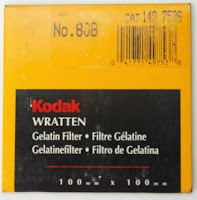
My dad was a local pharmacist and contracted with a camera shop down on Falls Road to provide film developing service for his customers. He was supportive of my hobby (so long as I didn't get the foolish idea that I could make a living looking at stars) and helped me to get a 2x2"Wratten 80A blue gelatin sheet and a mounting ring for the filter that was just a little smaller than the internal diameter of the refractor's dew shield. I carefully cut out my circle of blue, mounted it in the holder, dropped it into the front end of the scope and then waited for the next clear night. 

The view of Jupiter was quite pretty with its blue hue, but even after several attempts on different nights I still could see no GRS. (Of course, I am assuming that just by the odds I would have seen it on one of those evenings. I had not discovered Sky & Telescope with its listing of GRS transits yet, and online lookup would have been the glorious stuff of science fiction in the mid-60s). While filters lost a little of their charm from the experience, I felt that the principle was certainly sound. Reddish features would have their light blocked by a complementary blue filter, making them darker and easier to see. I began to suspect (correctly) that it was more an issue of small aperture than filter failure.

When I graduated to my 6" Newtonian I was finally able to catch sight of the Great Red Spot one evening without a filter. It had fairly good intensity back in the late 60's - similar to its appearance now. The availability of a glass filter that would screw into the bottom of the eyepiece was (as far as I knew) nonexistent. So no filters for visual inspection of my planetary quarry at that point in time.

But by now I was starting to play with using a second-hand Minolta range-finder camera to take pictures using the afocal method. Talk about a tedious hit or miss approach! You had to line up the camera over the eyepiece at where you think you are at focus, then hopefully get the planet in the field just based on the 6x30 finder scope, and finally snap the picture with a cable release while hopefully not jiggling the scope. Despite all that, I had occasional success with the technique. It also drove me to learn how to do my own B&W development rather than watch the photo lab assume nothing was on the roll of film and slice right through my field when trimming the negatives.

By this point I'm a HS freshman, networking with fellow amateurs at the Baltimore Astronomical Society and with enough pocket money from working at the pharmacy to buy some hobby stuff. I got another filter holder that would attach to the front of the Minolta and outfitted it with a Wratten blue gelatin. And then on a May evening in 1970 I did it - I actually captured the GRS photographically, a dark spot near the planet's central meridian. It was an OMG!! moment as I inspected that roll of film while hanging it up to dry. 
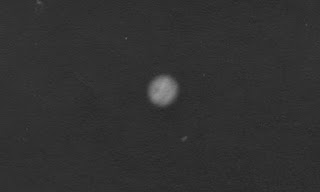
Jupiter - afocal method with 6" f/8 RV-6 at 140x
using Minolta camera with 80A filter

It was probably shortly after this that I began to find retailers of glass Wratten filters that we are so familiar with today. I started my collection with a #80A blue and it gradually expanded like a rainbow. Over the years I have found that, for visual planetary observing, they are not going the wow you like an O-III filter can do on an emission nebula. But they can be helpful if you approach their potential realistically, i.e., a tool that can improve the contrast of notoriously low-contrast planetary features. In addition, they do not cost an arm and a leg (at least not for the basic Wratten glass filters that almost any good astronomical supply house will carry).

Although I am given over more to imaging a planet rather than sketching it these days, I still do enjoy at the end of the session taking a few minutes to gaze upon my target before putting away the equipment. In doing so I'll almost always apply a filter in an effort to see the most that I can. Here are my common go-to filters using my 10" reflector (if you have a smaller scope then a corresponding filter with higher transmission rate may be a better fit):

The brilliance of our sister planet Venus means you have to knock down the glare significantly to be able to appreciate the disk. I often use a #47 Violet with only 13% transmission to accomplish that. The most I have been able to make out on Venus is some brightening at one or both polar regions ("cusp caps").

When Mars comes calling every other year it is a fun target and arguably one of the best for filter enhancement. The #80A medium blue is helpful in seeing the polar ice caps and lighter orthographic clouds that sometimes form. A light red #23A helps to darken the albedo features and boost their contrast. I have also found a deep yellow #15 to be a nice choice to reduce the planet's brightness and boost overall contrast.

Mars through my 6" f/8 RV-6 & Red #23A filter 10/7/2020


Jupiter is an absolute favorite for me given how dynamic it is. I have always found a yellow filter (#15 deep yellow or #11 yellow) as a good, all purpose aid to improving the contrast of the belts against the lighter zones. A pale blue (#82A) or medium blue (#80A) are helpful as well, especially with the Great Red Spot (the pale blue improves the contrast yet you can still pick out some of the red overtones to it).

While not as subtle as features among Venusian cloud tops, Saturn offers delicate features with its gradually darkening belts as you move from bright equatorial zone to dark polar hexagon. Again, a yellow filter seems to work well for improving the contrast a bit on the globe. 

Based on a very interesting "consumer reports" article on Cloudy Nights where author William A. Paolini compared multiple filters to find the ones that seemed to be the best for accentuating planetary detail, I have recently purchased a Baader Contrast-Booster filter. Now I just need to wait for this fall when we'll have Mars, Jupiter, and Saturn available for my own assessment of how well it does. 

If planetary observation is something you enjoy then you really should play around with some filters to see if they help you pick out some of the subtler details. Most retailers offer the Wratten color filters for under $20, and so long as you are not expecting miracles to happen, you'll likely find them an interesting and enjoyable accessory to have in your observing armamentarium. 

Friday, October 16, 2020

Mars Pays a Visit

Every two years & two months we are treated to a celestial show as Mars comes calling for a visit. For most of that 26 month interval the size of our brother planet is diminutive - under 5 arcseconds for nearly a year of that time, hovering around Uranus' size (3.8") for nearly 6 months.And as many amateur observers know, not all alignments are equal. Because of Mars' fairly elliptical orbit, the meetup can happen when Mars is at its farthest point from the Sun (aphelion) or when it's near its perihelion (or somewhere in between, obviously!). The difference is significant in terms of how large the disk will appear in the eyepiece (chart below). So perihelic oppositions are almost generational events, taking place every 15-17 years and boasting nearly twice the size of an unfavorable aphelic approach. It's little wonder that the excitement and anticipation for Mars fans has been growing all summer. Heck, I've even seen a lot more interest from the neighbors out for an evening stroll who know that Mars is "up there somewhere". It's a shame that Covid keeps me from sharing more than the image on my computer screen, and my hopes for a fun Halloween activity for the kids is gone as well.


Mars Size Over 2 Year Period

Range of Opposition Sizes

This apparition culminated in a closest approach on the night of October 6th, and opposition almost a week later on October 13th. That may seem odd at first - after all, all the other outer planets have their closest approach synced up with their opposition date. But for Mars we need to factor in its faster orbital rate compared to the gas & ice giants along with its orbit eccentricity. By October Mars was already past its perihelion point of its orbit, so that means with each passing day it draws farther from Earth. So it stands to reason we hit closest approach as a sweet spot a little before opposition since the two planets are pulling away from one another. So here's a pop quiz. The 2018 opposition took place before Mars' perihelion. Would the closest approach happen a few days before or after that opposition?

As if the orbital machinations aren't enough to make a good view of Mars elusive we need to add a wild card into the equation - dust storms. Planet-wide, rover-killing dust storms are not uncommon as the Martian atmosphere warms. And of course, warming is going to be at its most pronounced during the planet's perihelion. The much anticipated perihelic opposition of 2018 fell victim to an impressive global storm that hid features from our prying eyes and instruments for weeks.

But here's the good news - so far this opposition has been relatively free of dust storms, and at over 22" in size the views have been great! I had hoped to have my 10" reflector back in commission in time for the event but that did not pan out. My old reliable 6" RV-6 classic Newtonian has come through, however. On closest approach night using a light red filter (Wr23A) and an 8mm TMB planetary eyepiece (150x) I could see the wedge shaped Syrtis Major/Mare Tyrrhenum feature on the central meridian. A little pearl sat atop the south pole, the receding ice cap as summer has just occurred a few weeks ago for Mars' southern hemisphere. On the setting limb a distinct peninsula albedo feature, Mare Cimmerium, was easy to pick out. One thing I found quite interesting was the rather subdued appearance of Hellas which lies between Syrtis Major and the polar cap. Normally Hellas is quite a bright feature, but this time around it is muted for some reason. You could almost envision the combination of albedo markings looking like a steer head silhouette.


A few nights later near opposition evening I was able to get out and observe a slightly different portion of the Red Planet's globe with the same equipment. Here Syrtis Major was not visible, getting ready to rise on the limb. But Mare Cimmerium was in full view as well as dusky regions south of it where Mare Chronium also appears to be a little darker than I would have expected. And even though it's only been a week, I struggled this night to pick out the polar cap.

I also achieved a life-long desire to image Mars successfully. Two years ago my attempts were undermined by the dust storms and still learning the ropes a bit, acquiring better software and tools over the interval. My most recent addition has been a Baader UV-IR cut filter which serves to enhance images obtained with a color video camera. Playing with PIPP and Autostakkert!3 have also allowed me to tease out as much detail as I can. While I'm no where near the level of the incredible images I see in my role as ALPO AAC (posting images to the gallery), I feel pretty pleased with what I can produce with a smaller instrument and a setup far less costly than the leaders in amateur planetary photography. And after all, it's more about learning and improving, arriving at something that brings you joy and a sense of accomplishment. 

So, if you are an amateur astronomer I urge you to give this a go - Mars won't be this good again for 15 years. You don't need a big scope - I have caught albedo features and the polar cap using my 80mm Vixen earlier this summer (Of course by the time you read this the polar cap will likely be dissipated). If you are new to planetary observing then be sure to take your time at the eyepiece. At first you may not make out anything, but keep looking, waiting for those moments of atmospheric stability where you'll grab a quarter of a second of good seeing and pick out a dark marking. As your eye and brain work together you'll end up "integrating" those moments of clarity to fashion an image in your mind of what the planet looks like. Be sure to use a relatively high magnification, perhaps 30-50x your aperture in inches. Hopefully you have tracking ability so that you can relax while viewing the ocher orb, but even if you have to play bump & observe with your Dob, it's still worth it! I'd also suggest a rough sketch of what you are seeing as you observe, it not only gives you a memento for later but will improve your observing skill.

Mars with Pastel & Charcoal

Finally, even with just your naked eye, go out and admire that brilliant orangish beacon rising in the east. Drink in the setting, the place from which you are seeing it, the terrestrial scenery and sounds that accompany Ares as he rises amid the stars of Pisces. Let your mind ponder that at this moment we have rovers on its surface and orbiters whizzing above it, beaming back amazing images of this world. Take comfort in the rhythm and predictability of the heavens, especially now. And perhaps dream that, just maybe, the next time Mars gleams this bright you'll be able to say that humans have set foot on the Red Planet!


Doorstep Mars

Answer to pop quiz: Opposition was July 27 and closest approach happened 4 days later on July 31

Thursday, September 6, 2018

Solar System Summer

Every so often it seems the planetary action clumps together. I recall many moons ago when my friend Herman Heyn was doing his sidewalk astronomy gig very routinely that he found a few winters to be challenging to pique citizen interest. Of course being in the heart of light polluted Baltimore made things like the Orion Nebula or Seven Sisters seem a little drab. Compared to Saturn and its rings or Jupiter and its moons, the wow factor just isn't there.

The Family Poses on August 6, 2018
We're approaching that alignment again as Jupiter gradually catches up to Saturn. Two years from now the two superstar ambassadors to amateur astronomy will be huddled together amid the stars of Sagittarius. They'll also be relatively low in the sky for us mid-latitude northern observers, but that won't keep their fans from trying to catch a glimpse of them.

As Labor Day is in our rear view mirror I have to admit that this summer we had a great Solar System family gathering in the evening skies. There was brilliant Venus in the western sky, moving from gibbous to crescent phase all the while maintaining her cloudy veil. Not the best of evening elongations as the western ecliptic lies close to the horizon this time of year, but always a dazzling jewel that is worth visiting and pondering this hellish world - like a scientific experiment gone bad.

Jupiter and GRS in 6" f/8 Reflector July 29, 2018
Next came king Jupiter. This is my favorite planet - not only due to its ample size but especially due to its changing nature. On any given night you might catch a shadow transit on the cloud tops, or the Great Red Spot (which has definitely shrunk but also become a bit ruddier in complexion) staring back at you. Cloud bands with delicate features also await the patient observer or videographer. One evening after having chased down down M104 in my 80mm scope I decided to end with Jupiter to see what the little refractor could do. Cranking up the power with an 8mm TMB Planetary eyepiece + 2x Meade Barlow I was delighted to clearly make out the GRS moving towards the preceding (setting) limb as well as a black pencil point on the clouds betraying Io's presence as it cut across the disk. Old Jove - always the showman.

A couple hours east was full-tilt Saturn, rings wide open as the northern hemisphere has its maximum solar exposure. As he ambles towards Pisces over the next 7 years the rings will gradually fold up until they are razor thin. But for this summer they were in their full glory like a preening peacock - Cassini's division obvious, shadow play on globe and rings creating that wonderful depth of field sensation, tiny moons gathered around the globe. And subtle but evident clouds gradually darkening towards the pole. What's not to love about this view?

Mars on Aug 23, 2018

And finally, bursting onto the stage beyond Saturn was Mars - back with a vengeance from its roughly two year hiatus, sporting a good size disk that we won't see again until (yikes!) 2035. Even with the poorly timed arrival of a global Martian dust storm it still was enticing to see the polar caps and fuzzy albedo markings on the red one. Mars takes magnification well due to its brightness, so you mainly need some patience and steady skies to begin to see some details. Playing around with filters is also enjoyable to see what additional features you might tease out in the different light. While the show's not quite over, for this orb the motto is definitely Carpe Noctum.

Saturday, June 11, 2016

Mars Finally Poses

Mars has to be one of the most fascinating objects. Shy in that it only lines up for a good appearance once every couple of years, and then only for a few weeks. Even then the disk is small, requiring study to tease out the details.
But then the effort pays off - albedo features, ice caps, dust storms, clouds - no other planet offers such an array of Earth like features. This spring in late May Mars came to opposition in Scorpius - but the weather had been pretty overcast and wet. Added to that was Dave & Laura's wedding, so Mars would need to wait!
In a sad moment of hurried home repair I backed into my venerable 6" Dynascope and managed to snap loose the finder scope from the OTA. I was crushed, but at least the scope was still serviceable. So the first week in June I get the opportunity - set the scope out, get the laptop and video camera - somehow manage to target Mars without a finderscope. But wait - where's the USB cord? Noooo!! Nothing but bad luck, Mars holding on to its secrets.

Amazon shopping that evening for a good USB cable. And then - the laptop dies - or more accurately the fan in the laptop dies. More opportunity slides by as I await my repair, the red planet all the time receding from its closest approach.

Finally the conditions align again - a clear night, USB cable, laptop, everything I need. This time despite a tense moment when the video camera was not recognized at first I pull it off, reeling off a string of AVI files. Even on screen I can make out the polar cap in the south and various albedo features - looks like Mare Acidalium there hugging the polar region.

The Registax works its magic, and I am delighted with the outcome. All the effort is worth it - I have an image that is far and away my best ever of 4th rock from the Sun. Now if the weather cooperates maybe I can score one more session before Mars recedes too far to make details discernable! That's the problem with an addiction, you always want that next hit.    

Mars - June 10, 2016 10:45 EDT

Saturday, April 12, 2014

A Vague Mars, Awesome Tycho

Well this week was the 2014 Mars opposition, like the Olympics a bi-annual event in the life of amateur astronomers. I set up the scope under so-so skies the actual night of opposition (Apr 8th) but struggled to place Mars in the scope's field of view (spotting scope really needed to be reset, the tube was fully racked to the side I needed to move towards). So, with a first quarter Moon beginning its westward slide to the horizon I opted to grab a few frames from it craggy landscape.
The northern hemisphere sported Plato, always a favorite, but a little past prime as the sun had climbed high enough across its plains to remove most of the contrast shadows provide. The images were best without a Barlow, showing a wider section the the Moon's landscape. A little east of Plato the "Alpine Valley" was an interesting feature, an 80 mile long cleft amid the lunar version of the Alpine mountains. Another cool landmark was Mons Piton, a solitary mile-high mountain projecting from Mare Imbrium (Sea of Showers) a bit farther south and east of the Vallis Alpes.
Plato on the norther shores of Mare Imbrium
The southern hemisphere this evening was the normal chaotic mix of craters upon craters. Among the scared landscape two caught my attention. One was huge Clavius, always demanding attention because of its impressive size, nearly the distance from Frederick MD to the eastern shore of Maryland. Being an ancient crater its floor is beat up with subsequent smaller impact craters, a couple of which were easily seen. In contrast the other standout is one of the newer significant lunar features - crater Tycho was in sharp contrast and very eye-catching. Probably no other feature has such a remarkable change in appearance from its local dawn to high noon. Here as the sun just come above the horizon the steep walls and its nearly mile high central peak are evident. Less than a week from now it will be the ray system that draws attention from the observer, especially during the eclipse set to happen early next Tuesday morning.
Tycho at top center, large Clavius to the left
The following night I took some time to correct the finder scope and made another attempt at Mars. Being an aphelic apparition there is never a lot that one can hope to see with a modest 6" reflector. But throughout my astrophotography career Mars had always been one target that I could never capture through the scope. Always not at opposition, or too small when at opposition - it rarely presents itself favorably and never as consistently as Jupiter, Saturn, and Luna. But this evening I did manage to get it on screen, a clear disk with even hints of a polar cap. So I ran a few AVI to see what I could get, a couple with blue and green filters. Sadly, the processing revealed a very uninspiring result. Part of it is that clearly the "boring" side of Mars was showing, mainly plains without any significant albedo features. But even so the polar region was very mushy, more of a suggestion of its presence than a confirmation. So, the scope will need to be checked again, make sure I have the best mirror alignment possible, and then hope for another clear night with maybe a more fascinating central meridian available in the next couple of weeks. But - even as inferior as it is - I can at least say I now have Mars on film.

Mars with a small polar cap at about 5 o'clock
