Showing posts with label Accessories. Show all posts

Sunday, July 31, 2022

Attempting ADC

 I've attended a couple of sessions within the last year led by renown planetary imagers (Damien Peach, Agapios Elia) in pursuit of what I can do to refine my setup. One thing that both mentioned rather high up on their list was using an Atmospheric Dispersion Corrector (ADC) in the imaging train. The premise is that the atmosphere bends blue light differently than red light, causing a slight smearing of the "white" light we get at the eyepiece. An ADC, which is a set of adjustable prisms, allows you to correct the dispersion, yielding a sharper image. 

I had hesitated on acquiring one, in part because both individuals use large SCT units for their imaging - would a Newtonian benefit? Second, I had assumed (incorrectly) that the amount of smearing would be minimal once the planet got above 30° (see this). And finally, the Autostakkert software supposedly performs a correction for this when stacking.

Autostakkert "RGB Align"

I ended up convinced that it might be helpful so I got the ZWO model which was a past Sky & Telescope "hot product" award winner. The unit arrived about a week after ordering it, and as forewarned by my research, there were no instructions on how to use it. Fortunately other brave souls have sorted it all out and been kind enough to post video tutorials.


The unit is placed between your Barlow and the imaging camera. There are two steps for having it correct the atmospheric distortion:
  1. Use the bubble level to ensure that the unit is parallel with the horizon. That will obviously fall out of order as the evening progresses and your scope tracks the planet across the sky, so re-doing this step every half hour or so may be needed.
  2. Adjust the two silver levers (on right in picture) in equal but opposite directions until you can no longer detect color fringing 
It is that last step that can be tricky. One approach recommended by Martin Lewis is to overexpose the planet on your screen to make the fringing more obvious. You can then iteratively adjust the levers until the fringing is minimal (or at least you are unable to say which side is reddish one and the other bluish). Many of the imaging capture programs (e.g., FireCapture, ASI Capture) also have a utility to help assess your alignment. In general, when the circles overlap then you have achieved merging the spectrum back into white light. But given how wildly the two circles will bounce around on the screen it is still a bit of a swag. 

Performing ADC Alignment with Jupiter

This past week I decided to give it a go and placed the unit between Barlow and camera. Given the height of my set up, I had to use the step ladder to reach up to perform the leveling and then to gradually spread the levers, constantly referencing the laptop screen to see the impact. Of course another trick is to do it gently enough to not knock the planet out of the field of view. After about 5 minutes I felt the bouncing circles were are concentric as I might achieve. I did a focus and then started a couple of captures.

Sadly, what I noticed about 20 minutes in was that my focus was a bit soft. Looking at the focuser read out I noticed I was racked fully in due to the extra back space the ADC introduced. And sure enough, the actual focus point was just a tad further in. No amount of ADC will substitute for mushy focus, so I pulled it off and resumed imaging with a sharp focus. My task now will be to remove one of the spacers from the Moonlight focuser so that we can get to that focus point with the ADC in place.

Will it all be worth it? Hard to say, but given the feedback from well respected imagers I certainly am committed to finding out. And empirically it makes sense to try to correct this dispersion as the image is captured rather than to depend in post-processing algorithms to fully compensate for the effect. That's the game now - incremental improvement wherever I can achieve it.

Jupiter without ADC - can I tease out more with an ADC?


Sunday, June 19, 2022

Fine Focus

For any astro-imager, focus is always a primary concern. When doing deep sky it has to be spot on to get those tack sharp stars that we love to see. Fortunately for DSO imagers, there are aids such as a Bathinov mask that can help ensure you are on the mark.

Bahtinov Mask

 In planetary imaging it is a little more challenging. We also need to be in perfect focus to capture the subtle details, but a Bathinov mask isn't going to work on a non-point light source. Trying to move the scope to a bright star to focus first before centering the planet also seems to fall short. What one is left with is manually fiddling with the focus knob while watching a feature of the planet to get it as sharp as possible. For example, a Jovian moon or the Cassini division are often good targets to pay attention to in this effort.

Unfortunately the planetary imager is confronted with another problem: the high magnification utilized to get the planet's disk to a suitable size. This means that the slightest touch causes the planet to wildly dance in (and sometime exit from) the field. The result is an iterative set of focus-recenter-evaluate attempts until you feel it is as good as you can get (or your patience is gone and you settle for "close enough"). When rebuilding the OTA for my 10" Cyrus1 Newtonian I even invested in a nice JMI focuser with a feather touch micro-focuser, but it still didn't solve the fallout of a human hand touching the scope.

I finally came to accept that investing in a motorized focuser was going to be necessary to solve the problem. Based on the positive experience Dale Ghent had with MoonLite focusers for HALO, I opted to order from them. It takes a bit of time to go through all the various options but I eventually balanced my desire for bells & whistles with my budget to get a Crayford 2" focuser with their universal adapter and stepper motor for about $700. To my surprise and delight they had the unit to me within about a week.

Next came replacing the existing JMI with this snazzy unit. If you look at their universal adapter, it is "a plate with multiple many different 4 bolt hole patterns for Newts over the years, Meade, GSO, Orion, Celestron, etc." 


However, none of them aligned with the existing holes I had placed into the tube when installing the JMI focuser. So it became a tedious process of securing the plate with a couple of openings that did align and then trying to accurately measure where the new hole had to be drilled to accommodate where the opening was on the plate. After a couple of hours the plate was finally secured and motorized focuser attached. 


Installed MoonLite Focuser

As you can see from the picture above, this is a substantial unit. It occurred to me that this would probably alter the scope's balance once I added in the Barlow, camera, and possibly an Atmospheric Dispersion Corrector (ADC). In the past the scope had always been a little "rear heavy" when imaging, requiring placement of a magnetic weight along a shelf bracket that runs along the front half of the tube. I opted to install a similar bracket along the back half of the scope, and indeed it was needed to achieve balance when I did a dry run.


A couple weeks later with Jupiter and Saturn getting a reasonable (if not great) altitude in the pre-dawn skies, I gave the MoonLite unit a test run. I did not purchase a separate hand controller to operate the focuser but instead attached it to the laptop using the provided USB cable. The unit also has to be powered - so yet another cord dangling from the focuser that I tried to tuck alongside the scope to avoid any tension or vibration it might cause.


The interface is pretty intuitive, allowing you to move in or out by orders of magnitude. Once Saturn was centered it was easy to display the planet in the video capture software and have the MoonLite Single Focuser app on top so that I could watch the planet as I commanded the focuser to adjust its position. During the process there was minimal movement of the planet and no risk of knocking it out of the field. I ended up getting what I felt was as good a focus as I could achieve and was happy with the result after I processed the video captures the next day (below). 

While the swapping out of the original JMI for the MoonLite ended up being a little challenging in the installation stage, I'm very happy (and blessed) that I could do it because the results are what I was looking for - a far less painful and far more accurate focusing experience. Like so many other hobbies, amateur astronomy (especially when coupled with photography) is an investment. It seems to be a continuous process of identifying what might improve our ability to see or photograph the heavens and then budgeting to make that next upgrade.


1 I call it the "Cyrus" telescope because the optics were made by Charles Cyrus, a friend and excellent ATM from back in my days with the Baltimore Astronomical Society. After Charlie's passing his instrument made its way to me and I have enjoyed it for a couple of decades now, most recently redoing the OTA that houses the mirror.

Monday, May 30, 2022

The Dogs' Globular

Tucked under the Big Bear's tail is the tiny constellation of Canes Venatici, Boötes' hunting dogs. For such a small constellation it might be accused of celestial gerrymandering by having its borders claim such deep sky masterpieces as M51 (Whirlpool galaxy) from Ursa Major and M3 from the herdsman. 

Messier 3 is a wonderful globular boasting half a million suns packed into its perimeter. Even from Towson you can sweep up this dandy DSO as a fuzzy 6th magnitude star roughly midway between Arcturus and Cor Caroli (the α star of Canes Venatici). My 6" RV-6 Newtonian at medium magnification and averted vision shows a brighter core and some of the members of the cluster winking in and out with averted vision. The 10" Cyrus reflector exposes many more suns and begins to hint at the true majesty of this object. 


When planets aren't around for imaging I will give the deep sky a go. In this regard I'm not very hard core, using my  unmodified Canon EOS t6i rather than a dedicated unit, and I have not invested in things such as a field flattener that the more serious imager might do. I also do not currently have a guide camera, relying on a good polar alignment and shorter ~30 second shots to keep stars from trailing. I use a simple illuminated tracing pad to serve as light source for my flats. I have invested in a copy of PixInsight for processing, and will probably be plumbing the depths of its functionality for years to come. So when at the end of April we had a pleasant evening, a little chilly but with pretty good transparency, I rolled the mount out of the garage, attached the Vixen, and set off to see if I could get a nice scrapbook photo of the globular.

One of the things that I wanted to try out was my recently purchased Baader Moon & Skyglow filter to see if it could cut down on the nasty light pollution in my stacked image that I so often encounter when doing deep sky. The company claims "it darkens the spectral region which is particularly marked by street lamp light, which is the biggest contributor to the nightly Skyglow". The second thing I was interested to evaluate was BackyardEOS, a software package that allows you to automate a sequence of exposures taken with the camera. In the past I had turned on the camera's built in Wi-Fi and used the Canon app on my tablet to take the exposures. But that gets tedious fairly quickly, firing off an exposure every 20-30 seconds. 

The time spent on polar alignment was worth it as the scope dutiful slewed over to Arcturus for a quick focus check with the Bahtinov mask in place. From there we slid up to M3 and began the session shortly after the passing of astronomical twilight. The BackyardEOS performed quite well as I set up a series of 30 second exposures over 15 minutes. At the end of each run I would check that the globular was positioned near center and that no star trailing was evident. After 6 such runs I then set about acquiring the dark and flat exposures.

Of course, collecting the data is only half the game. The stack in Deep Sky Stacker looked pretty good when I did an auto-stretch in PixInsight. The light pollution detritus was much reduced, so high marks for the Baader filter doing its job fending off the neighbors' lights. This time, in my search for a good PixInsight workflow, I followed along with a YouTube video made by Richard Bloch. It was one of the best I've watched so far, easy to follow along and enough rationale provided for why you are taking certain steps. It ended up helping me produce a pretty nice image of this cluster of suns that was the first faux comet entry that Messier himself is thought to have observed. 

It is always satisfying to see your work improve, and I was happy to find that my small investment in the two new tools did help me in my desire to occasionally snatch a deep sky portrait from the driveway of my home.


Thursday, March 17, 2022

A Filtered Experience

The topic for the HAL meeting this evening was "filters", which is a pretty big topic! After all, we have filters for visual use vs. imaging use, and then filters for specific targets from faint DSO to our brilliant Sun. Hopefully I provided a little insight at the session based on my personal experiences, especially as to planetary observing.

Back in '65 when I got my first scope, a classic 60mm refractor with .965" high-powered eyepiece, I knew one thing for sure that I really wanted to see was Jupiter's Great Red Spot. The scope showed the planet as a fuzzy disk with slight rainbow fringe, perhaps a stripe or two upon it, but no GRS in sight on the multiple occasions I target the giant planet. Somewhere - probably a library book that I had borrowed - I read how a blue filter would darken the GRS and therefore make it stand out better. Clearly that would make my target materialize in the eyepiece!

My dad was a local pharmacist and contracted with a camera shop down on Falls Road to provide film developing service for his customers. He was supportive of my hobby (so long as I didn't get the foolish idea that I could make a living looking at stars) and helped me to get a 2x2"Wratten 80A blue gelatin sheet and a mounting ring for the filter that was just a little smaller than the internal diameter of the refractor's dew shield. I carefully cut out my circle of blue, mounted it in the holder, dropped it into the front end of the scope and then waited for the next clear night. 

The view of Jupiter was quite pretty with its blue hue, but even after several attempts on different nights I still could see no GRS. (Of course, I am assuming that just by the odds I would have seen it on one of those evenings. I had not discovered Sky & Telescope with its listing of GRS transits yet, and online lookup would have been the glorious stuff of science fiction in the mid-60s). While filters lost a little of their charm from the experience, I felt that the principle was certainly sound. Reddish features would have their light blocked by a complementary blue filter, making them darker and easier to see. I began to suspect (correctly) that it was more an issue of small aperture than filter failure.
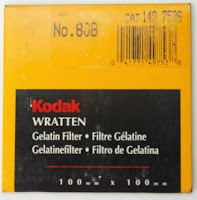

When I graduated to my 6" Newtonian I was finally able to catch sight of the Great Red Spot one evening without a filter. It had fairly good intensity back in the late 60's - similar to its appearance now. The availability of a glass filter that would screw into the bottom of the eyepiece was (as far as I knew) nonexistent. So no filters for visual inspection of my planetary quarry at that point in time.

But by now I was starting to play with using a second-hand Minolta range-finder camera to take pictures using the afocal method. Talk about a tedious hit or miss approach! You had to line up the camera over the eyepiece at where you think you are at focus, then hopefully get the planet in the field just based on the 6x30 finder scope, and finally snap the picture with a cable release while hopefully not jiggling the scope. Despite all that, I had occasional success with the technique. It also drove me to learn how to do my own B&W development rather than watch the photo lab assume nothing was on the roll of film and slice right through my field when trimming the negatives.

By this point I'm a HS freshman, networking with fellow amateurs at the Baltimore Astronomical Society and with enough pocket money from working at the pharmacy to buy some hobby stuff. I got another filter holder that would attach to the front of the Minolta and outfitted it with a Wratten blue gelatin. And then on a May evening in 1970 I did it - I actually captured the GRS photographically, a dark spot near the planet's central meridian. It was an OMG!! moment as I inspected that roll of film while hanging it up to dry. 
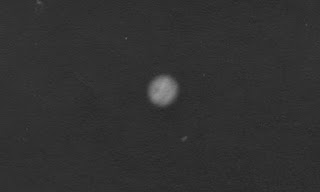
Jupiter - afocal method with 6" f/8 RV-6 at 140x
using Minolta camera with 80A filter

It was probably shortly after this that I began to find retailers of glass Wratten filters that we are so familiar with today. I started my collection with a #80A blue and it gradually expanded like a rainbow. Over the years I have found that, for visual planetary observing, they are not going the wow you like an O-III filter can do on an emission nebula. But they can be helpful if you approach their potential realistically, i.e., a tool that can improve the contrast of notoriously low-contrast planetary features. In addition, they do not cost an arm and a leg (at least not for the basic Wratten glass filters that almost any good astronomical supply house will carry).

Although I am given over more to imaging a planet rather than sketching it these days, I still do enjoy at the end of the session taking a few minutes to gaze upon my target before putting away the equipment. In doing so I'll almost always apply a filter in an effort to see the most that I can. Here are my common go-to filters using my 10" reflector (if you have a smaller scope then a corresponding filter with higher transmission rate may be a better fit):

The brilliance of our sister planet Venus means you have to knock down the glare significantly to be able to appreciate the disk. I often use a #47 Violet with only 13% transmission to accomplish that. The most I have been able to make out on Venus is some brightening at one or both polar regions ("cusp caps").

When Mars comes calling every other year it is a fun target and arguably one of the best for filter enhancement. The #80A medium blue is helpful in seeing the polar ice caps and lighter orthographic clouds that sometimes form. A light red #23A helps to darken the albedo features and boost their contrast. I have also found a deep yellow #15 to be a nice choice to reduce the planet's brightness and boost overall contrast.

Mars through my 6" f/8 RV-6 & Red #23A filter 10/7/2020


Jupiter is an absolute favorite for me given how dynamic it is. I have always found a yellow filter (#15 deep yellow or #11 yellow) as a good, all purpose aid to improving the contrast of the belts against the lighter zones. A pale blue (#82A) or medium blue (#80A) are helpful as well, especially with the Great Red Spot (the pale blue improves the contrast yet you can still pick out some of the red overtones to it).

While not as subtle as features among Venusian cloud tops, Saturn offers delicate features with its gradually darkening belts as you move from bright equatorial zone to dark polar hexagon. Again, a yellow filter seems to work well for improving the contrast a bit on the globe. 

Based on a very interesting "consumer reports" article on Cloudy Nights where author William A. Paolini compared multiple filters to find the ones that seemed to be the best for accentuating planetary detail, I have recently purchased a Baader Contrast-Booster filter. Now I just need to wait for this fall when we'll have Mars, Jupiter, and Saturn available for my own assessment of how well it does. 

If planetary observation is something you enjoy then you really should play around with some filters to see if they help you pick out some of the subtler details. Most retailers offer the Wratten color filters for under $20, and so long as you are not expecting miracles to happen, you'll likely find them an interesting and enjoyable accessory to have in your observing armamentarium. 

Sunday, March 7, 2021

Got to GoTo?

So if I yelled "Tastes Great!...Less Filling!" - what comes to mind? If you grew up in the 80's (and maybe even if you didn't) you'll recognize that as the catch phrase for Miller Light beer, ranked as one of the most successful marketing campaigns of that era. It epitomizes the situation of two camps staking out and digging in around their assessment of a product. 

Amateur astronomy has certainly seen its share of hotly debated issues. For many years as digital photography came to the marketplace we sparred over whether it would (or even could) replace film for capturing quality images of deep sky targets. That one seems to be settled. Then there is the occasional discussion of whether digital media is better than a hard copy. I'll confess that I still like a book/magazine/newspaper in its printed format over the digital. There is something thoroughly enjoyable about thumbing through a volume of Burnham's Celestial Handbook, perusing a constellation that will be available for viewing that night. But as the digital revolution has unfolded we also enjoy the portability and accessibility of online content.

One enduring topic of debate is most certainly the merits of using a computerized mount with "GoTo" capability when you are out under the stars. For the better part of 50 years I've been a star hopping guy, planning my trip to that evening's targets with a little research and printed maps to outline the approach to be used. Sometimes half the fun was that research and planning to capture the target, and then successfully bagging that faint fuzzy provided a sense of achievement and affirmation of my skills. Undoubtedly it gave me a foundation of the heavens and the ability to bring a variety of celestial showpieces into the eyepiece on any given evening without any aids.

As I've noted in prior postings, last August I invested in a Celestron CGX-L mount. My main motivation was the hope of better tracking for some photography and the ability for it to bear a larger OTA than my old Orion Atlas mount could handle. One of the features of the mount is, of course, "GoTo" functionality. I will confess that it's very seductive. 

My current project has been revisiting the AL Urban List objects using my 80mm Vixen refractor. The open clusters in Monoceros are particularly challenging since there are very few stellar guideposts available amid Bortle 8 skies to serve as a foothold when setting out on the star hop. So when taking the scope out this past week on a cold and clear winter evening my prep was primarily generating a list of objects along with a very brief description. Once aligned the mount did a fantastic job of centering the targets, leaving me time to inspect and sketch each of them. Where I might have bagged one, possibly two, of these clusters by star hopping I was instead treated to a very pleasant and productive session before my toes became too numb.

I would submit that there are strong parallels between "GoTo" functionality and our reliance on satellite navigation when driving to an unknown destination. It's said that many under the age of 25 simply have no skills for picking up a map and using it to see where they are and how to get where they need to go. While I do make use of apps like Wase from my phone, especially in heavy traffic or when driving solo to someplace I've not been to before, I often will not bother if the route is one I'm reasonably familiar with. As a teenager delivering prescriptions for my dad's pharmacy in Baltimore I acquired a pretty good sense of the main arteries and thoroughfares around here, so it seems natural to eschew the voice giving me commands and go my own way. It may be that getting your terrestrial bearings and navigating from a map is going to be relegated to a sort of black art practiced by old codgers like myself. I am still amazed sometimes how the person behind the counter is totally reliant on the cash register to determine the change due from a $7.23 meal when I hand them a $10 bill. Thanks dad, having me work at the pharmacy taught me that one as well.

But back to our task of celestial navigation. There is another value to star hopping beyond getting a grasp of the sky. As noted by Bob Prokop in a recent thread on the HAL group, you have no idea what little gems you are gliding past when in autopilot mode. I specifically recall stumbling across the beautiful double star WZ Cassiopeia one night on my way to NGC 7790. I likely spent more time looking at that then the intended target.

Perhaps the appropriate balance for a new telescope owner with the technology is to challenge themselves to star hop to the brighter Messier and Herschel 400 objects. It is not that hard and gives you the satisfaction of bagging the target based on your skills, not your equipment's. Take your time when sweeping the area for your quarry and soak in the neighborhood, letting your eye search for colors and your brain form interesting patterns among the field of stars. Simply because it does not get called out on an atlas doesn't mean it's unworthy of a few moments of admiration. But then when the need arises to find (or confirm) the end point of a challenging star hop, you'll find that computer assistance to be a real boon. Yes, computerized mounts can be highly efficient, but is that really where the enjoyment lies in amateur astronomy for you?

Friday, January 29, 2021

Circumventing an Obstacle

Roughly 18 months ago I pulled the trigger on a PoleMaster for my Atlas mount. If you're unfamiliar with the instrument, it's a digital camera that attaches to the front of your mount so that it is aligned with the RA axis. Then with accompanying software you can perfect your alignment to achieve the best possible tracking from your system. While there are other gadgets and techniques that are useful to get a good polar alignment I found this system to be a solid, workable approach for me.

My Orion Atlas mount has been a good work horse for well over two decades in my observing. It was my first "real" mount that could adequately track the sky, opening up not only a more pleasant observing experience but also planetary "lucky imaging" with my 6" reflector and then deep space targets when I acquired my Vixen 80mm scope. It was portable enough to fit in the back of my Rogue, traveling with me to nearby Alpha Ridge or out to Wyoming as part of my Great American Eclipse road trip. The power source was never a worry - a simple battery pack of 4 D cell batteries that seemed to last forever (and easily acquired at the corner drug store if they were to give out.)

Leo Triplet
The "Leo Triplet" taken with Vixen 80mm & Atlas mount

But even with the PoleMaster, the tracking was not accurate enough to allow for exposures beyond 20 seconds, causing me to resort to a very large number of short subs in order to arrive at a respectable image. Another shortcoming is the weight bearing capacity of the Atlas - there is no way it would be able to support my 10" reflector that I am hoping to complete refurbishing this year. After taking several months to research various mounts on the market that would work within my budget I finally took the plunge and invested in a Celestron CGX-L mount which arrived in September.

In the almost six months since acquiring the CGX-L I have had it out perhaps a dozen times. The first couple were to simply get acquainted with the unit (I am glad no one witnessed my first night when it took me over 40 minutes to realize that there was an "on" switch that had to be toggled - I had just assumed that when I plugged in the battery that it was ready to go like my Atlas!) With it powered up I followed the instructions on how to perform a two-star alignment with an optional 4 additional stars. Once that was done the computer assisted tracking worked surprisingly well. And, truth be told, that "goto" functionality really makes me feel like I'm cheating after a lifetime of star hoping. 

Polar alignment, however, is back to roughly eyeballing the RA axis in the direction of Polaris. According to the manual one also can precisely align to NCP following the star alignment process by entering the "align mount" routine. In theory, you center a star in your eyepiece and then the computer moves the scope to where the star should be if you were properly centered on the pole. Your task is then to use the mount's azimuth and altitude controls to center the star and thereby refine your polar alignment.

CGX-LI will confess that I have yet to try this routine. I could not help but want to use the PoleMaster which worked so well. But, alas, the design of the CGX-L has a handle bar directly in front of the RA axis of the mount. It seemed that I would not be able to have my cake and eat it too - those handles are indispensable for positioning the heavy mount head onto its tripod. 

Thinking I was likely not the first CGX-L owner to feel frustrated by this obstacle I spent time searching online for solutions that others may have come up with to use their PoleMaster. And, as so often happens, the Internet did not disappoint. On Cloudy Nights there was a reference to a guy who designed a literal workaround; a 3-D printed component that attaches to the face plate with a detachable U shaped bracket to hold the PoleMaster camera. Genius! Brilliant! And the best part was that he was selling them on eBay with about a week's turn around time. The credit card came out within sixty seconds of watching the video demo of it. 

Last month I finally got the chance to install the adapter and try it out. The Celestron mounting plate was readily removed and replaced by the custom printed plate. The U bracket's holes aligned beautifully with the PoleMaster camera so that I could transfer it from the Atlas adapter to the 3-D one. And to make attaching the U bracket to the face plate foolproof the creator provided two guide pins that snap into place thanks to a couple of strong molybdenum magnets. (It brought back memories of my dentistry days, fabricating dentures that seated and held fast with the use of such magnets - but that's a story for a different blog 😉). The video below shows the component and how easy it is to use. Problem solved!


I have a feeling that this recent experience reflects yet another paradigm shift for amateur astronomy. While 3-D technology has been around for a while it is clearly becoming more mainstream and allowing imaginative engineers to bring their designs to rapid prototype and market. We recently had a discussion on HAL's email group regarding this very topic, and several folks chimed in about how they were using parts/accessories created in this fashion. In the "good old days" this was the realm of the machinist who had access to a shop where equipment could turn out custom parts. What we may lose in the durability of a machined part is going to be offset by the accessibility to many more people with innovative approaches to solving problems and creating new tools for our astronomical community. I can hardly wait to see what comes next!
