Monday, July 31, 2023

Registax Heir

 A critical part of the planetary computer assisted video imaging (CAVI) - aka "lucky imaging" - is the sharpening of the stacked and aligned image with wavelets. It can seem like a black art as you push and pull levers to apply various wavelet changes to the image to make it clearer. There is also a huge amount of art here, where one balances between a heavily processed and artificial looking output vs. one that has left details on the table that should be brought out.

Registax has been the de facto freeware for the application of wavelet sharpening for quite some time. However, the last release was in 2010 - a virtual lifetime when it comes to a software product. As a result there have been alternatives emerging that the amateur imager may want to evaluate.

One of the new kids is waveSharp, and part of the attraction is that this is an open source project by Cor Berrevoets, one of the primary forces in the development of Registax. As stated in his announcement on CloudyNights of the availability of waveSharp at the end of last January,  

(Registax) was developed in 2011 only for windows 32bit computers, waveSharp is developed for 64bit computers and multiple operating systems (WIN64, LINUX, MACOS). Therefore this application is only meant to sharpen/enhance images that have been created using other software (alignment/stacking).

You can download the compiled executable for placement on your computer at the project's GitHub repository.


The interface is pretty clean, allowing you to open your image and then use sliders to apply the strength of your wavelets. Unlike Registax we have only 3 sliders, with the first one affecting the small-level detail, the third increasing the contrast on larger scale features. The "Denoise" (smoothing) sliders are not activated by default but must have their checkbox selected. 

The user also can select one of three filters to apply. Gaussian appears to be very similar to Registax, with the changes slow and gradual to create a sharpened image. ZeroGauss is quite strong, with minor adjustments having significant effects. The third choice, Bilateral, is supposed to help avoid the "rind" effect that we often see in planets like Venus and Mars with bright limbs. 

I've been using waveSharp for about two months now and have been very impressed with it. The changes are applied quickly (possibly a reflection of its 64-bit architecture) and the various filters are a nice touch. You can also save your settings and recall them for application to new images. The one thing that is probably not as easy as Registax is correcting RGB alignment (atmospheric distortion) to your image - it appears to be more automated in Registax. 

Change is inevitable but not always positive. While waveSharp is still in its early development it seems to be a suitable heir to the venerable Registax - give it a try!

Friday, June 16, 2023

Hanging Out in the Crib

Amateur astronomy has a bit of a reputation for needing significant and sophisticated equipment to enjoy. And if you are looking to target faint objects, or dive into photography, well then there is certainly some truth to that. But the universe has so much to offer, and some of those items really do not need much more than a nice venue and a pair of binoculars (or your eyes) to touch your soul.

One such type of event is an appulse1, "an approach between two celestial bodies." As the Moon makes its monthly trek along the ecliptic it will often pair with one of the brighter planets. Due to the various inclinations of their orbits to the ecliptic sometimes we have wide space between the two, or on rarer occasion the Moon will cover up (occult) the object for a period of time. There are also four 1st magnitude stars that lie sufficiently close to the ecliptic that they can sometimes be visited in the sky by one of the denizens of our solar system. I'll leave it as a research project for those interested in identifying them if you're not familiar with that quartet.

A little more subtle (unless, perhaps, you are in very dark skies) are the three open clusters that lie close enough to the ecliptic to also host one of the planets. Interestingly, these all lie in the Winter Zodiac. The Pleaides is the brightest and most spectacular of the trio. It also lies the farthest off the ecliptic at 4° and so will have infrequent visitors. Every 8 years Venus drops by for a visit to the Seven Sisters, making for a beautiful alignment. 

Venus Amid Pleaides

While M35 in Gemini does not have a catchy moniker, it does own the inside post position to the ecliptic, lying only 52 arc-minutes away. As a result it is more common to see interlopers jog by it, especially Jupiter which has a low inclination to the ecliptic and so unable to stray far from it. It is also noteworthy that M35 comes very close to the point in the heavens where the Sun reaches its greatest northern culmination (i.e., the Summer Solstice) - a conjunction that we can never observe unless there were a Total Solar Eclipse in progress. Talk about your rare event!

The Sumer Solstice - June 21, 2023 11am EDT

Finally we have M44, the "Beehive" cluster in Cancer. A little more than a degree off the ecliptic it also is in position to allow the occasional planetary orb to join its aviary for a night or two. While not as dense or showy as the other two clusters, it is still easily visible to the naked eye from dark skies and was known in antiquity as Praesepe (the "crib"). Sailors used it as a barometer since if it was hidden from view by a veil of thin cirrus clouds then overcast skies and possibly rain was in store for the next day.

All spring there has been a celestial chase between the Goddess of Love and the God of War unfolding in the evening twilight. Venus has been gaining on the Red planet, pursuing him through Taurus, Gemini, and now Cancer. In early June Mars attempted to hide himself among the stars of M44 for a couple of days while Venus drew near to Castor and Pollux to seemingly inquire as to his whereabouts. The dual appulses were beautiful and could be appreciated by one's eyes or simple binoculars. I happened to be at South Bethany in Delaware visiting my sister those evenings, and sitting out back along the canal watching the scene emerge as darkness fell was simple & sublime. 


While I couldn't take my scope, my Canon camera and a tripod were easy to bring and allowed me to create my own postcard souvenir of the trip. Taking a series of 10-sec shots at 18mm captured all the players on stage, and then as darkness fell a set of 3-sec shots at 55mm allowed Mars to have the spotlight as a ruby set amid the glittering bees. Simple processing in freeware such as Deep Sky Stacker and Sequator produced wonderful results with additional enhancement in Photoshop.

Appulses and other simple pleasures of the night sky are encountered multiple times a year. Don't overlook the opportunity they provide to sit back and drink in the profound majesty of the heavens in an uncomplicated way.

1 This is basically another term for a conjunction


Monday, May 22, 2023

Ultra Venus

Perhaps no other object has such a wide gulf between its naked eye impression compared to its appearance in a telescope than Venus. In our twilight sky Venus demands attention, shining like a brilliant diamond. Whenever the crescent Moon stops by for a visit, I am always up for grabbing a few shots (even though I already have many prior encounters documented). And when our sister planet pairs with another planet (as it did earlier this year with Jupiter) or the Pleiades, amateur astronomers turn into paparazzi and flood the online galleries with their glamor shots.

Venus & Jupiter Feb 28, 2023

But few of those amateur astronomers will tarry very long with Venus in the eyepiece. The view is that of a dazzling, featureless cue ball emulating one of the Moon’s phases. Nothing stands out so it’s a quick check-in and on to something of greater interest.

With patience and some filtering there is more to see. A deep violet Wratten #47 filter not only knocks down the glare but provides subtle boost to the very low contrast features in the Venusian clouds. While at times one might make out a dusky region on the planet, the most common feature that appears is a brighter region at one (or both) of the poles. Know as a “cusp cap” it is an actual feature and not just an artifact manufactured by our brain. Large Hadley cells rise high into the atmosphere from the hot equatorial regions and then sink back down in the high temperate latitudes, forming a slightly darker “cusp collar” bordering the cooler cusp cap.

Planetary imagers also find themselves stymied by Venus’ reluctance to share features. Like most others, my prior attempts to record details on the 2nd rock from the Sun using “lucky imaging” techniques produced crisp but bland captures of the globe.


Our professional brethren have also struggled with Venus until about a century ago when astronomer Frank Elmore Ross targeted it using Mount Wilson's 60- & 100-inch reflectors. His gig before that was a decade at Eastman Kodak studying photographic emulsions and filters, which led him to make photographs in IR and the newly released UV filter. While the IR failed to penetrate the cloud layer to show details as he had hoped, the UV unexpectedly did. Curiously, there was not much follow up to his discovery until images acquired by French amateur Charles Boyer nailed down a rotation period of about 4 days. His results were published in 1960 in Icarus (and rejected by none other than Carl Sagan). While radar data eventually established a retrograde rotation of 243 days for the planet, Boyer’s observations of a 4-day “super-rotation” of the Venusian atmosphere were eventually confirmed by Mariner 10. Thus we end up having two longitudinal “systems” for tracking central meridian on Venus: CM I for the surface, and CM II for the upper atmosphere clouds.

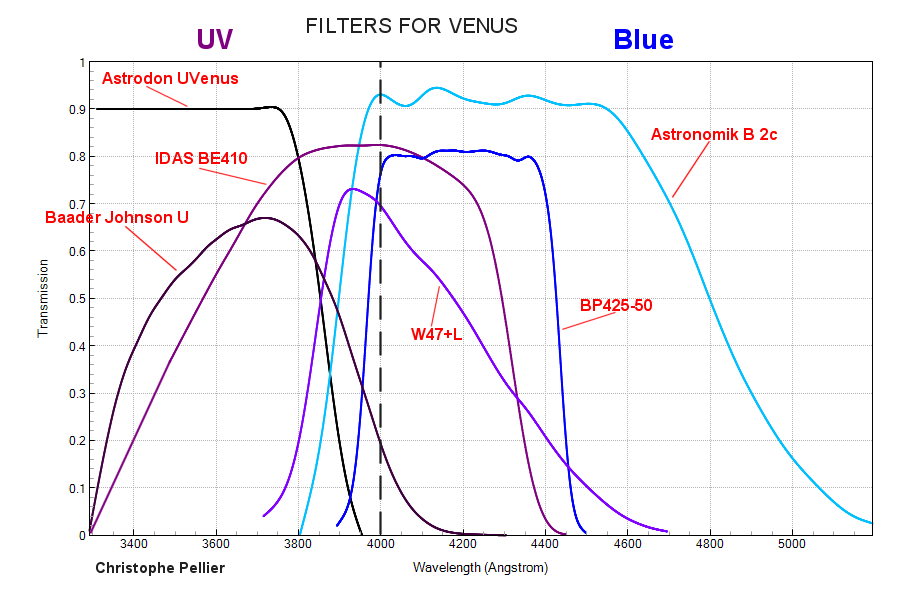
Over the last ten years amateur planetary imagers have gradually been targeting Venus using a UV filter and getting some nice results. UV filters are pricey (north of $200) and sometimes backordered for months. I finally budgeted for the Atrodon UVenus filter which was heralded as having some of the best UV transmission. Renowned imager Damien Peach put together a video on his patreon channel that provided further tips on obtaining a successful UV image such as combining it with an infrared blocking filter since many UV filters leak IR which can smear the image.

Sample transmission for UV filters


With Venus approaching its greatest eastern elongation (distance in our sky) from the Sun, it was time to try again to capture cloud details on our neighboring planet. Starting at sundown I worked on centering the planet with good focus to begin acquiring my UV videos. Reasonably calm seeing is really important for achieving that focus and often not present when dealing with an object like Venus that is never more than about 40° high, but I finally got that on my May 15th session. I confess that I was pretty ecstatic being able to make out what seemed to be a southern cusp cap on the image shown on the laptop during acquisition, implying I would have something worthwhile to work with. And the next day when putting the video through my processing workflow I ended up with a nice result, clearly showing north and south cusp caps with some of the darker collar. The center of the planet shows segments of lighter and darker clouds.

Venus May 15, 2023 in UV


In my researching about capturing Venus in ultraviolet I came across a few sources that argued that introducing any sort of lens element in the imaging train (e.g., a Barlow lens, an SCT corrector plate) was to be avoided if possible since these can cut down on the amount of UV light considerably. The ideal situation is a mirror telescope such as my 10” Newtonian. For the heck of it I did a capture at the end of the session using the Barlow. While the seeing may have deteriorated by that point, my results certainly seemed to confirm that the benefit of a larger image was far offset by the decline in sharpness of the low contrast cloud features.

So, what do the darker regions represent? In classic Venus fashion the planet will not give up that information yet. Some scientists believe that it is a photochemical reaction in the atmosphere that results in UV absorbing material. However, there are even some who argue it could be cloud based microbial life generating these regions and liken it to algae blooms that we see here on Earth. With a bevy of spacecraft heading Venus' way later this decade we may eventually get an answer to this question.

As usual I submitted the final results to ALPO. A few hours later I heard back from Julius Benton, the Venus section coordinator. “Thanks. Your UV image looks very good!” was great feedback to receive, and confirmation that the multi-year journey to acquire the equipment and knowledge on how to make Venus finally give up some details was satisfying indeed.

Saturday, April 22, 2023

Something to Crow About

There is real joy when the pleasant spring weather sets in, providing evenings of cool temperatures that I can tolerate with only a light jacket but the bugs cannot. Our garden spotlight softly illuminates the beautiful azalea newly flush with coral colored blossoms and the nearby deep purple irises. The distinctive clink of an aluminum bat connecting with a pitch let's me know that nearby Towson University is having a game this evening. Well, that and their stadium lights lighting up the tippy top of the trees in the field behind my house is also a dead giveaway. 

After setting up the scope I minimize what light pollution that I can by turning off the yard lights. This evening I'm hunting Crow - some celestial highlights of Corvus as he wings his way towards a midnight rendezvous with the meridian. As my night vision slowly improves I struggle a bit to discern the outline, a geometric pattern of half a dozen 2nd-4th magnitude stars. 

The first stop is an eye-catching asterism known as the Stargate. Lying roughly a degree southwest of M104, there is a good chance you may have already stumbled upon it when looking for the Sombrero galaxy. One could probably sweep it up in a star hop by extending a line from Virginis and Spica westward about 12°, but I take the easy way out and key in the coordinates. At times with a computerized mount you feel like Picard on the Enterprise, barking out the location and issuing a "make it so!" pronouncement. 

At low power in the 10" Newtonian it is delightful - a triangle of stars within a triangle, each having one of the triad much fainter than the other two. Not really seeing any color here but the arrangement is very cool. A little higher power makes it easier to see the fainter members of each of the dual triangles. So what the heck is a "stargate"? Well, near as I can tell, this is a reference to the spaceship portal used in the 80's sci-fi series Buck Rogers in the 25th Century. Hey - if the Greeks can fashion a crow from a trapezoid on a stilt then a "stargate" ain't half bad!


From an easy asterism I go in search of my next objective - planetary nebula NGC 4361, an entry in the Herschel 400 list. If you can see the top of Corvus' trapezoid it would likely be fairly easy to target this with a Telrad. However, the scope is well-aligned so I succumb to the GoTo siren and ask it to do the work for me. I inspect the field at 25mm without any filter, but there's no sign of anything unusual in the eyepiece. Adding the Lumicon UHC and studying the area once more leads me to believe that there is a faint dab of light when using averted vision. Taking the magnification up to 95x with the 16mm + UHC filter darkens the background a bit more and makes me far more certain that I’ve got this 11th magnitude planetary. I use my makeshift drape/balaclava to block out extraneous light in hopes of getting a better look and maybe even catch the central star which is an incredibly hot Wolf-Rayet star, checking in at 270,000° Kelvin (compared to our Sun at about 5,700° K). While I can see the glowing orb a little better it fails to tease out the nebula's progenitor. The nebula appears circular and fairly evenly illuminated, perhaps twice the size of Jupiter. While given the moniker of "The Water Sprinkler" based on images of it that show internal detail, in my scope I discern a faint, glowing orb best seen with averted vision and lacking any structure. The field it is set in is very sparse, made more so due to the use of the UHC filter.


Next in my Corvian exploration is S1604 (Struve catalog entry #1604), one of the targets listed in the AL's Double Star program. This double is not in a very friendly star-hopping  location with multiple other similar stars near it and no solid anchor point to start from. It isn't listed among the keypad’s roster of double stars, so I do a quick lookup of the RA and Dec and key the coordinates. Having expended the effort at the outset of the session to get a good alignment pays dividends as the scope dutifully moves to the spot. Looking over the field at 25mm there are a couple of candidate suns that may be the target, and I think I see one of them as a double. Bringing the magnification up to 156x and revisiting each one I quickly confirm the right one. S1604 reveals itself as a splendid triple system that closely replicates a right angle. The two comes are very close in magnitude with the brighter one making a N-S alignment (PA ~0°) and the other E-W (PA ~90°) with the primary. This is curious, as Burnham's Celestial Handbook lists the position angles as 91° and 73°, clearly at odds with what I am seeing (and what is listed in the AL Double Star program list). Why the difference - is it an errata in Burnham's? I find it hard to accept that the stars changed position that much (especially given one of them is believed to be an optical alignment rather than a true common pair). Not sure that I am picking up any color here, although the faintest of the trio might have a ruddier glow to it.


Saving the most challenging for last, I set off for the Antennae galaxies - NGC 4038 and 4039. This duo of roughly 10th magnitude interacting galaxies should be doable in a 10" telescope, but the challenge becomes plucking them out from the bad light pollution. While the GoTo had been doing very well, for this item I decided to use my star hopping skills to have certainty that I was over the target. Locating TY Crv lying west and midway between g and e Corvi, I nudge the scope northeast until I encounter the 8½ and 9½ magnitude pair of SAO 157047 157046. From there it’s almost due north to HD 104496 and SAO 157048 where the galaxies should be found more or less midway between these two stars. I navigate the route with a high degree of confidence, reaching the endpoint and earnestly scanning the eyepiece field. Alas, there is nothing there to greet me. I check carefully with the 16mm and then the 9.7mm eyepiece, and then repeat the process using the Baader Moon & Skyglow filter. I even grab the balaclava once more to shield my eyes from extraneous light, but there is simply nothing to be had. Perhaps another, clearer evening, or waiting to try in early morning hours next winter, would bear fruit. Sadly the light pollution wins this round.

Star hopping to the Antennae


It's been a very satisfying evening under the stars with my feathered friend. While I'm tempted to continue looking for other spring objects in the area I decide to pack things up since I'll need to be at work in the morning. And that is part of the beauty of our hobby, the heavens (usually) will offer you another opportunity to explore its wonders, even amid suburban skies.


Tuesday, March 7, 2023

Under the Influence

The Howard Astronomical League lost one of their luminaries last month with the passing of Bob Prokop. The club never had a more ardent supporter than Bob, serving in the leadership role as a club president and supporting many of the club's outreach activities. He loved our hobby and it showed in many ways.

While I never had the opportunity to develop a personal relationship with Bob, I was certainly under his influence. He had the ability to advocate for the spectacular above us as well as the sublime. Was Mercury having a favorable apparition? Bob would be posting about it in the email group. Was the Moon's libration tilting a far-flung crater into a better position for us to grab a look at it? Our lunar expert knew the when, where, and how of the circumstances. On more than one occasion his exhortations found their mark and nudged me outside to hunt down what Bob was showcasing.

Bob was indefatigably upbeat about any clear night. Do NOT complain to him that the full Moon was ruining the evening lest you be embarrassed by Bob's retort as to the lunar features, asterisms, or other bright destinations that would not be suppressed by a glorious full Moon. And everyone in the club knew that he wasn't Googling that information, it simply flowed effortlessly from his years gazing up at the heavens. I still recall a passing comment that I made - something along the lines of "only a mediocre double star" - to which I was called to account in a most affable manner.

One thing that Bob and I were resolutely in lock step on was the value of star-hopping. We both cut our astronomical teeth by using instruments that required you locate your object rather than simply dialing it in. To quote Bob, "Of course, I am also the nut who has my telescope on an unmotorized alt/az mount with no finder scope... and can still find that 9th magnitude star faster than anyone with their fancy go-to software!" No brag, just fact.

I understood his lament that "today's kids" miss the anticipation and preparation involved when stalking a faint object, not to mention the thrill and sense of accomplishment when it finally appears in your eyepiece. Plus, who knows what stary vistas and uncharted beauty you may encounter along the path to your objective? While I have succumbed to the GoTo siren with my latest mount, I still do put the keypad down at times and drive myself to my destination. 

While my interactions with Bob were virtual, they were valued nonetheless. He was a welcome inspiration and source of knowledge for me and many of my club peers. He was one of those special people I've had the good fortune to come across who's love of the night sky was palpable and contagious. 

Tuesday, February 21, 2023

Getting Started

It's a question that I (and most amateur astronomers) get from friends from time to time: "I want to look at stuff in the sky - what sort of telescope should I get?" It is a tough question to answer because there are a multitude of variables (like how dark your sky is), a wide variety of celestial objects for which each has a "best" instrument, and the prospective user's existing familiarity with the night sky. 

It is understandable why folks get the urge to grab a scope and go out into the night. The images sent back from our spacecraft are stunning to say the least. And while most people grasp that their telescope is going to fall short of a billion dollar scientific instrument, they likely also have acquaintances posting to Facebook or Instagram with some pretty cool stuff. That's part of the problem with social media - it makes stuff look easy since we only display our victories, not the flubs we made getting there.

OK, so rather than totally dodging the question with a "it depends..." answer, let's consider the following scenario. We have a newbie who really knows very little about finding things in the night sky and who lives in suburbia (where their sky is not going to be bleached out by a ton of lights). They'd love to see a galaxy, some beautiful star clusters, and maybe a nebula (gas cloud) or two. They'd like to see Saturn's rings and Jupiter's Great Red Spot.

Those two sets of objectives (Deep Space Objects [DSO] and Solar System Objects) are somewhat mutually exclusive for our beginner. DSO present the challenge of being faint and potentially very difficult to find for a new telescope user. Of course you can buy a scope with computer assisted GoTo that will point the telescope to the object if you can align it properly (not to mention that you'll be jumping into the hobby for a much bigger financial bang). 

Planets, being brighter, are much easier to find with your telescope. However, features like the polar ice caps of Mars and the belts of Jupiter are more subtle than you might imagine to pick out with your eye. It's almost like playing an instrument with planetary observing - you need practice before you can detect some of the cool things your telescope can show you.
So - how can you break into this hobby without breaking the bank? The answer lies in a nice set of binoculars. Most people don't even consider them because they believe they are not powerful enough. The truth is that their wide field and additional light gathering power will indeed open up a lot of celestial DSO for you. They have the added benefit of being user friendly - no need to align anything, just pick them up and step outside to begin exploring. And - they pack easily for that trip to the beach or the mountains where the skies are much darker than at home.

There are a lot of sites with binocular recommendations. One thing to know up front is that the first number in the binocular description is the magnification (or power), the second is the diameter of the front lens (larger diameter = ability to see fainter objects). I personally own two pairs: a 7x50 by Celestron and a 15x70 by Oberwerk. The former are reasonably light and easy to use, the latter are a bit heavier but give wonderful views. I'd recommend a 7x50 or 8x56 for someone starting off - something you should be able to do for under $150 easily.

Binoculars - ready to go & user friendly!

"Sky Safari" App

Equipment is only half the battle. The really important thing is to begin to learn your way around the sky so that you can find things to look at. You don't need the binoculars to start this, your eyes and a star chart (or, even better, an app on your smart phone that can simulate the sky where you point the phone) are all you need. Start learning to identify the bright stars, then trace out the other stars in the constellation that has the bright star. From there see if you can locate stars in some of the dimmer constellations between the bright stars. As you do this you'll also become familiar with how astronomers quantify the brightness of an object (its "magnitude"). Once you've made friends with the stars overhead you can use them as markers to find the more interesting stuff.

Like what? Well, on a crisp February night you could swing by the Orion Nebula, a hydrogen gas cloud birthing new stars. Or high up in the sky catch the Seven Sisters (Pleaides), a beautiful collection of diamonds in the sky. For something more subtle you can track down the oval smudge of light that is the Andromeda galaxy lying some 2 million light-years from Earth. And since Jupiter is out in the evening sky take a moment to check it out - you may not see the Great Red Spot but you'll likely get to see some of its moons very close by as little stars. For other ideas I'd suggest picking up a book such as Touring the Universe Through Binoculars and let it guide you to a lot of fascinating destinations.

The tiny cloud represents the Orion Nebula
(It looks much better from dark skies)

An important lesson that you'll quickly learn is that when it come to the night sky a camera is much better equipped to show color and detail than our eyes. The camera opens its lens and collects light for many seconds, our eyes take an instantaneous reading of the photons. As such you'll not see the pinkish tinge in the Orion Nebula nor the spiral arms of Andromeda. But, you still do get to see them first hand, and that can be rewarding and exciting as well.

Orion Nebula - 2 sec Exposure

If you are still at it with your binoculars some 6 months later and you want to take the next step, then I'd say invest in a telescope. A great idea would be to go to a local club's star party and look through a variety of telescopes. But even if you can't, you cannot really go wrong getting an uncomplicated Dobsonian telescope in the 6-10" mirror size range. The additional light gathering power and magnification will open up a much larger range of DSO that you can hunt down from your yard.

Of course if it turns out that the thrill of seeing faint fuzzies in the sky does not give you the satisfaction you were hoping for the binoculars can always be used for checking the wildlife in your backyard - or getting an up close look at the horse you're betting on in the fourth race at Pimlico. 😏


Monday, January 30, 2023

C/2022 E3 (ZTF)

Last March the folks at the Zwicky Transient Facility picked up an object using their wide field survey. It was soon determined that this was a comet heading inbound for a rendezvous with the Sun after a 50,000 year absence. The orbital calculations along with the comet's brightness led astronomers to predict that C/2022 E3 (ZTF) might become a naked-eye object soon after its perihelion on January 12th, peaking as it makes its closest approach to Earth on February 1st. Given it's the brightest comet to grace our skies since Neowise in the summer of 2020 I thought it was worth trying to observe it and possibly get an image or two last Friday.


Jan 27, 2023 21:45 ET from Towson, MD
Clear skies, 35°F with light wind
Seeing 3/10 Transparency 9/10

First up is a quick scan of the area just a little NW of β Ursae Minoris (Kochab) using the 15x70 Oberwerk binoculars. At 2nd magnitude and a deep orange color it is easy to pick out Kochab from even my Bortle 8 skies to start the brief star hop. A little pan to the right and up and I can quickly see what appears to be a tiny, weak nebulosity. Working to hold the binoculars steady enough to get a good look I confirm that we have a comet that should be an easy target.

Rolling the 10" Cyrus Newtonian out I ditch getting 2-star alignment in favor of just using the finder scope to target the fuzzy visitor. It's readily visible in the spotting scope so it doesn't take long to sweep it up in the 40mm eyepiece. It's set in a nice star field and there is a star-like nucleus along with a diffuse, weak haze representing its coma. No real color can be discerned. Bumping up to the 25mm Plossl to darken the background a bit the coma is a little easier to see but in all honesty I cannot make out any shape to it that would let me guess as to the presence of a tail and its direction. It certainly seems to be at about 5th magnitude as predicted.


To round out my ZTF session I grab my Canon camera and put the kit 70-300mm lens on. This time I try to avoid focus issues by targeting the almost 1st quarter moon and dialing it in to be as sharp as possible. At 200mm focal length I should get a reasonable size for the comet, and the rule of 500 suggests an exposure of 2½ seconds. But a quick test exposure shows unacceptable trailing at 2 seconds, so I drop it back to 1 second and begin firing off pictures, accumulating about 100 of them. From there I drop the focal length down to 70mm and run a series of 6 second exposures before calling it a night.

A few months ago Sky & Telescope ran a nice spread on nightscape photography. Among the tools that they mentioned was Sequator, a free program that I had not heard of before that stacks your images and can "freeze" the foreground. Sounded like a perfect tool to use for my ZTF images, so I downloaded and did a quick YouTube video to get me oriented to its use. I have to say it was much easier and faster than my standard go-to in this scenario (Deep Sky Stacker), although it could not keep my foreground tree from blurring, likely because of the breeze shifting its branches. But the resulting TIF yielded a very nice result after having some tweaking in Photoshop, especially given the minimal effort I put into the capture.


While the comet is outbound to the Kuiper belt deep freeze, we do have a couple of opportunities to get some interesting shots of it as it photo-bombs a few celestial luminaries as it leaves the stage:

Feb 6: The comet swings close by Capella
Feb 11: ZTF buzzes Mars
Feb 15: The green ghost will contrast nicely with nearby Aldebaran

While comet C/2022 E3 ZTF is likely to fall short of the media hype, it still is an interesting and readily accessible example of what most comets look like - star-like nucleus encased by a puffy, tenuous cloud.