Showing posts with label UV. Show all posts

Monday, December 18, 2023

When Smaller Is Better

Venus is a notorious tease. Her brilliance in the deepening twilight sky is a lure to any beginning astronomer, yet nearly all come away disappointed after centering the planet in the eyepiece. No details are to be had (at least none to an untrained eye without the aid of a filter) other than the changing phase of a featureless cue ball. 

The exception is when we view Venus in UV light. Thanks to an as yet unknown compound in the Venusian atmosphere that absorbs ultraviolet light the planet shows structure in its omnipresent cloud deck. As we know, UV is not something our eyes can discern. The best we can do visually is to apply a violet filter such as a Wratten #47 that reduces the glare a teases out a tiny bit of that structure as low contrast shadings. Most common of these (and with a scientific rationale for their existence) are the "cusp caps" seen at either or both poles.

All is not lost, however. The amateur who has outfitted his rig for planetary imaging can take advantage of the fact that the camera's sensor can record in UV. Some cameras are better than others in terms of their sensitivity in the UV portion of the spectrum, but even if you do not happen to have one of the more UV friendly models the odds are good that with the addition of an ultraviolet filter you can capture some details. A little over a year ago I purchased an Astrodon UVenus filter to pair with my ZWO ASI178MC (color) camera to see if I could capture the cloud patterns, and was delighted to have success earlier this year.

In researching the best approach to obtaining a good image of Venus in UV one of the tips that I ran across was to avoid lenses in the optical path. The anti-reflection coatings on them can apparently cut down on the UV transmission, making the image dimmer (and consequently requiring a lower frames-per-second rate that introduces atmospheric smearing). It has also been noted that the corrector plate on an SCT is not designed to provide correction in the UV range, so that design may be a bit handicapped when attempting UV capture.1

Another factor I have noticed is that while you can detect cloud markings when Venus has become a large but slender crescent on either side of an inferior conjunction, the results seem far more interesting when the phase is somewhere greater than 35%. Enough of the disk is presented to allow one to often capture cups caps/collars as well as streaks in the middle of the planet that a crescent won't show.

My recent session a couple weeks ago was under average seeing with only fair transparency. Our sister planet was sporting a 70% phase and a diameter of only 16" as the planet continues to pull away from us following last August's inferior conjunction. Having to forego the 2.5x Barlow means it is a small image that one gets to work with, but it was clear even on the laptop screen during capture that the cusp caps were visible. Post processing can afford some help in enlarging the image (such as adding drizzle in AutoStakkert3!, leveraging the resizing functionality in Registax, or even using a custom resizing application like Topaz's GigaPixel product).


Since I had the time I decided to do a second capture, but this time with the Tele Vue 2.5x Powermate Barlow in the imaging train. I could immediately see the impact in terms of a dimer image, dropping my fps from 32 down to 9. This of course allows more time for atmospheric blurring to occur, reducing the number of frames of steady seeing that can be harvested. 


So while the image was certainly larger, the attenuation of UV light by the Barlow gave an image with far less clarity. Yes, the cusp caps are there, but the details in the smaller image, even after undergoing enlargement, were far superior. The verdict was clear - leave the Barlow in the box and work with whatever size we have to get the best UV image of the elusive Venusian cloud details.

1 https://www.thefreelibrary.com/Imaging+Venus+in+the+ultraviolet%3a+a+new+development.-a0357147028 


Monday, May 22, 2023

Ultra Venus

Perhaps no other object has such a wide gulf between its naked eye impression compared to its appearance in a telescope than Venus. In our twilight sky Venus demands attention, shining like a brilliant diamond. Whenever the crescent Moon stops by for a visit, I am always up for grabbing a few shots (even though I already have many prior encounters documented). And when our sister planet pairs with another planet (as it did earlier this year with Jupiter) or the Pleiades, amateur astronomers turn into paparazzi and flood the online galleries with their glamor shots.

Venus & Jupiter Feb 28, 2023

But few of those amateur astronomers will tarry very long with Venus in the eyepiece. The view is that of a dazzling, featureless cue ball emulating one of the Moon’s phases. Nothing stands out so it’s a quick check-in and on to something of greater interest.

With patience and some filtering there is more to see. A deep violet Wratten #47 filter not only knocks down the glare but provides subtle boost to the very low contrast features in the Venusian clouds. While at times one might make out a dusky region on the planet, the most common feature that appears is a brighter region at one (or both) of the poles. Know as a “cusp cap” it is an actual feature and not just an artifact manufactured by our brain. Large Hadley cells rise high into the atmosphere from the hot equatorial regions and then sink back down in the high temperate latitudes, forming a slightly darker “cusp collar” bordering the cooler cusp cap.

Planetary imagers also find themselves stymied by Venus’ reluctance to share features. Like most others, my prior attempts to record details on the 2nd rock from the Sun using “lucky imaging” techniques produced crisp but bland captures of the globe.


Our professional brethren have also struggled with Venus until about a century ago when astronomer Frank Elmore Ross targeted it using Mount Wilson's 60- & 100-inch reflectors. His gig before that was a decade at Eastman Kodak studying photographic emulsions and filters, which led him to make photographs in IR and the newly released UV filter. While the IR failed to penetrate the cloud layer to show details as he had hoped, the UV unexpectedly did. Curiously, there was not much follow up to his discovery until images acquired by French amateur Charles Boyer nailed down a rotation period of about 4 days. His results were published in 1960 in Icarus (and rejected by none other than Carl Sagan). While radar data eventually established a retrograde rotation of 243 days for the planet, Boyer’s observations of a 4-day “super-rotation” of the Venusian atmosphere were eventually confirmed by Mariner 10. Thus we end up having two longitudinal “systems” for tracking central meridian on Venus: CM I for the surface, and CM II for the upper atmosphere clouds.

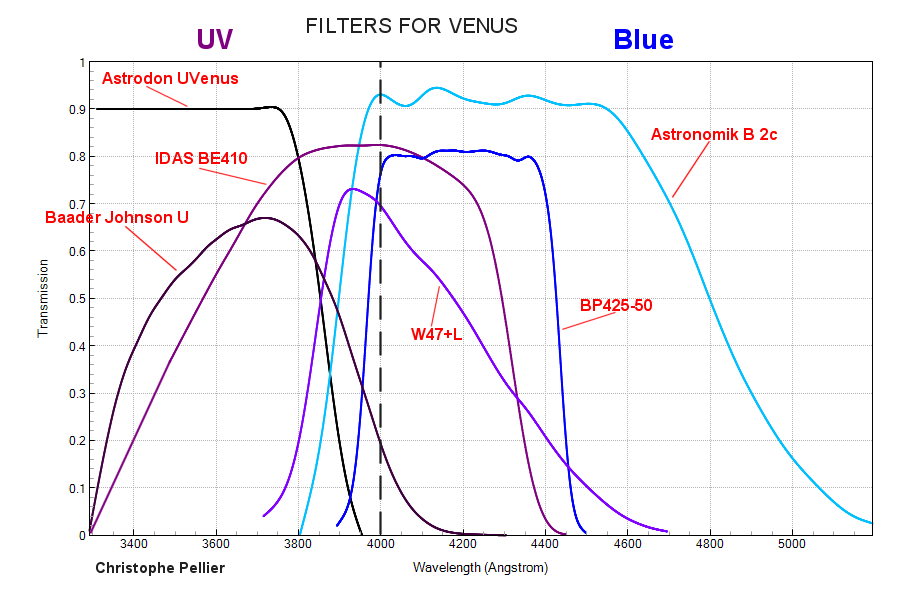
Over the last ten years amateur planetary imagers have gradually been targeting Venus using a UV filter and getting some nice results. UV filters are pricey (north of $200) and sometimes backordered for months. I finally budgeted for the Atrodon UVenus filter which was heralded as having some of the best UV transmission. Renowned imager Damien Peach put together a video on his patreon channel that provided further tips on obtaining a successful UV image such as combining it with an infrared blocking filter since many UV filters leak IR which can smear the image.

Sample transmission for UV filters


With Venus approaching its greatest eastern elongation (distance in our sky) from the Sun, it was time to try again to capture cloud details on our neighboring planet. Starting at sundown I worked on centering the planet with good focus to begin acquiring my UV videos. Reasonably calm seeing is really important for achieving that focus and often not present when dealing with an object like Venus that is never more than about 40° high, but I finally got that on my May 15th session. I confess that I was pretty ecstatic being able to make out what seemed to be a southern cusp cap on the image shown on the laptop during acquisition, implying I would have something worthwhile to work with. And the next day when putting the video through my processing workflow I ended up with a nice result, clearly showing north and south cusp caps with some of the darker collar. The center of the planet shows segments of lighter and darker clouds.

Venus May 15, 2023 in UV


In my researching about capturing Venus in ultraviolet I came across a few sources that argued that introducing any sort of lens element in the imaging train (e.g., a Barlow lens, an SCT corrector plate) was to be avoided if possible since these can cut down on the amount of UV light considerably. The ideal situation is a mirror telescope such as my 10” Newtonian. For the heck of it I did a capture at the end of the session using the Barlow. While the seeing may have deteriorated by that point, my results certainly seemed to confirm that the benefit of a larger image was far offset by the decline in sharpness of the low contrast cloud features.

So, what do the darker regions represent? In classic Venus fashion the planet will not give up that information yet. Some scientists believe that it is a photochemical reaction in the atmosphere that results in UV absorbing material. However, there are even some who argue it could be cloud based microbial life generating these regions and liken it to algae blooms that we see here on Earth. With a bevy of spacecraft heading Venus' way later this decade we may eventually get an answer to this question.

As usual I submitted the final results to ALPO. A few hours later I heard back from Julius Benton, the Venus section coordinator. “Thanks. Your UV image looks very good!” was great feedback to receive, and confirmation that the multi-year journey to acquire the equipment and knowledge on how to make Venus finally give up some details was satisfying indeed.