Saturday, February 26, 2022

A Tangent on Venus

In last month's blog I chronicled my effort to see Venus as it skirted north of the Sun during its inferior conjunction. It was not a particularly easy task but certainly doable in clear skies. This month I'm doing a little armchair astronomy because that experience made me ponder when circumstances would be at their best to capture Venus as it moves between our home planet and the Sun.

Trigger warning - math is used in this blog post!

While you could spend time scouring the Internet to find the maximum distance that Venus can lie from the Sun during an inferior conjunction, where's the fun in that for anyone with geek tendencies? If we dust off our trigonometry and get some basic orbital elements we should be able to swag an answer to our question. 

It always helps to define some terms before solving the problem. The ecliptic is the plane in which the Earth orbits the Sun. In considering the orbits of other members of our Solar System we can speak of the inclination (tilt) of their orbit relative to Earth's orbit. Those two planes will intersect at two nodes (points). One node (the descending node ☋) would be when the neighboring planet is heading south when it crosses through our orbital plane, while the other (ascending node ☊) it is northbound. What is curious is that there does not seem to be a term for the point 90° farther along the orbit, where the planet would lie maximally above or below our ecliptic. For the sake of discussion, I'll call the point in the orbit where the planet lies at its greatest distance above (north) of the ecliptic as its cresting node and its southern counterpart as its sinking node.

Step 1: How far above the ecliptic does Venus lie when at its cresting (or sinking) node?  

We can readily find Venus' inclination to the ecliptic (3.4°) as well as its average distance from the Sun (a) and then calculate how far above the plane it lies (b) using basic trig:

b = a ÷ cot(θ)

Plugging in to the formula:

a (Venus-Sun distance) : 108 million km

cotangent of 3.4° = 16.8

b = 108/16.8 = 6.4 million km

Step 2: Knowing how high above the ecliptic plane Venus lies at cresting/sinking node and the distance between Earth and Venus at inferior conjunction, we can calculate the angle as seen from Earth for how far above the Sun Venus will appear in the sky: 


θ = tan-1(b ÷ c)

b (height of Venus above ecliptic): 6.4 million km

c (Earth-Venus at Inferior Conjunction): 42 million km 

tangent ratio: 6.4 ÷ 42 = 0.1524

arctan(0.1524) = 8.67°

Wow - that is almost the length of the upper bowl of Big Dipper. My observation back in January had a distance of 4.8°, a little better than half the best it could be. So having determined the "what", let's turn our attention to "when" we would see one of these inferior conjunctions where Venus is at its cresting node.

This June will mark a decade since the last time Venus transited the Sun. As you may know, these events are quite rare, occurring as a set of transits 8 years apart. In the context of our ecliptic plane and Venus' plane, the inferior conjunction must occur while Venus is moving through its ascending or descending node in order for us to see a transit. And that is why they are confined to a few days around June 8th (as it reaches its descending node) or December 8th (ascending node). If our cresting node can reasonably be assumed to occur midway between June 8 and December 8, the approximate date for it would be on March 8th. As a result, for those of us in the northern hemisphere, an early springtime inferior conjunction will be our best opportunity to catch a glimpse of our sister planet directly above the Sun. 

From a listing of past and upcoming inferior conjunctions, we have the following ones that occur in March:

March Inferior Conjunctions
3/30/2001
3/29/2009
3/25/2017
3/23/2025
3/20/2033
3/18/2041
3/15/2049

Searching online for the inferior conjunction that happens March 23, 2025 we find the difference in Declination between Venus and the Sun will be + 7.5° - adhering pretty well to our predictions. With any luck I'll be around and have a clear day to set up the scope and try yet again to image the event.

A final observation before closing out this post. As discussed in April's 2020 blog when Venus traversed the Pleaides, our sister planet takes just shy of 8 years to return to nearly the same point in our sky. We see that 8 year interval again in the table above where each subsequent inferior conjunction arrives a couple days shy of 8 years. What if we look at the most recent inferior conjunction January 8th and project it out in an unscientific way to estimate its future conjunctions by simply adding 2,920 days repeatedly to it:

January Inferior Conjunctions
1/8/2022
1/6/2030
1/4/2038
1/2/2046
12/31/2053
12/29/2061
12/27/2069
12/25/2077
12/23/2085
12/21/2093
12/20/2101
12/18/2109
12/16/2117

Hmm - the next Transit of Venus is set to occur on December 11, 2117. We didn't land on it exactly because of our estimating shortcut, but there's no doubt that the most recent inferior conjunction is gradually walking the calendar backwards to become the next transit event, gradually losing a little of its northern clearance above the Sun's limb on each conjunction until it finally ends up crossing the orb.

If you have persevered to the end of this geeky blog entry - congratulations! It's probably due in some measure to the fact that, like me and the multitude of ancient astronomers that came before us, you find the patterns and rhythms of the heavens amazing and fascinating to explore.




Sunday, January 9, 2022

Lunchtime Venus

Since late last spring Venus has been an evening star in our skies, shining brilliantly in the southwest. It was not the best of apparitions for those of us at mid-northern latitudes as it hung out in the basement of the zodiac when reaching its greatest distance from the Sun. I only managed a couple of casual observations and a single imaging attempt due to the planet often being obstructed by trees or buildings from my home observing venue.

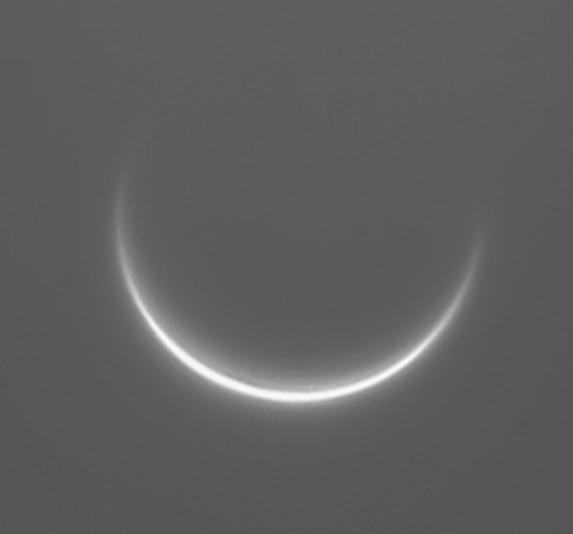
Like all evening appearances of our sister planet, the transition from evening to morning star is defined by Venus reaching "inferior conjunction." This event, where the planet passes between Earth and the Sun, was set to occur on Saturday, January 8th around 7:40 p.m. our time. If the Earth-Venus-Sun orbital alignment were straight on we would witness Venus transiting the face of our home star at each one of these passages. But, just as we are not treated to a solar eclipse at every new Moon, Venus' orbital inclination of 3° to the ecliptic causes her to glide north or south of the Sun. Only roughly once a century do we get to witness a pair of transits, spaced eight years apart, with the most recent taking place in June of 2012.

This weekend's conjunction saw Venus skirting Sol's northern limb by about 4.5°, leading most websites such as In the Sky to state

At closest approach, Venus will appear at a separation of only 4°51' from the Sun, making it totally unobservable for several weeks while it is lost in the Sun's glare.

S&T Image Credit

In actuality, to describe it as totally unobservable is perhaps a bit of an exaggeration. It's one of those observing challenges that can be done, albeit with great care since even a brief exposure to the Sun's surface through any sort of optical aid can easily damage your retina. I've viewed Venus in the daytime before, both naked eye and with telescope, on numerous occasions, but had never attempted an Inferior Conjunction sighting. With the forecast for conjunction day looking quite good I decided to take up this challenge.

My hope was to actually get an image of the event, so I arose before dawn to mount the 6" reflector and perform an alignment. After battling some passing clouds I finally got the Celestron mount able to slew to a target with reasonable accuracy. I left the drive running and waited for my quarry to rise high enough in the eastern sky to view it. 

By 10:30 a.m. the winter Sun was well placed so I attached the camera and asked the mount to center Venus. I had placed a red filter in the optical path to help boost contrast against the bright blue sky, but the screen was still a bright, featureless canvas. I tried slowly sweeping the area a little bit to no avail. I finally removed the camera and substituted a 16mm eyepiece to see if I could make a visual sighting, but that, too, ended in failure. I reluctantly broke down the equipment and headed inside.

Not quite willing to accept defeat, while eating lunch I plotted my next attack. I considered that Venus should be positioned pretty much at the 12 o'clock position relative to the Sun's disk at this time. What if I positioned myself such that the apex of the neighbor's house blocked old Sol? Would that allow me catch Venus in the sky above the roofline with binoculars? I grabbed my trusty 7x50 Celestron binoculars and headed outside to find out. I swept the area until my arms grew tired with still no sign of the planet. As a last ditch effort I brought out the 15x70 Oberwerk binoculars to see if they might do the trick. After about five minutes - there!! A surprisingly bright, tiny crescent lying on its back was visible above the rooftop. It was a little surprising how clear one could distinguish the crescent shape and how white, like snow, the disk seemed in the blue sky. 

I hurried inside to grab the Canon and telephoto lens in hopes of capturing a shot using the same technique. When I emerged and used the Oberwerks to try to relocate Venus I struggled. Where the heck was it - I had just seen the darn thing. Then fate lent a hand when a jet billowing a contrail behind it crossed the field. Within a few seconds I had identified Venus again. Once the contrail had dissipated, it was again tough to pick out the tiny crescent. A few minutes later another jet deposited its white contrail in the vicinity, and again it became easier to pick up Venus in the field. Thinking about this I suspect that as the field jostled from my unsteady hand the planet moved with the contrail, thus becoming more apparent to my brain. Whatever the actual reason it was an undisputed truth that having the contrail in the field made picking up the planet easier.

In yet another testimony to our eyes' logarithmic response to light, the photos appear to have been a bust as well since exposures long enough to possibly pick up Venus were overexposed. The result is in a field containing a wide range of light intensities, our eyes will provide a good image whereas it is often impossible for the camera to capture it. And although I may have come away with no photographic proof of my success, the experience adds another page in my book of  amateur astronomy that I will have fond memories of.

A digital sketch of Venus & Contrail


Sunday, December 19, 2021

Great Expectations

As the holidays unfold, we can be certain that a multitude of shoppers are weighing the decision of putting a telescope under the tree for a loved one. As seasoned amateur astronomers, we often try to provide advice on potential purchases to friends and strangers alike on social media. Increasingly there are good resources made available by the amateur community on what is a good starter scope for the newbie in hopes of avoiding a “hobby killer.”

Unfortunately, the seed of a budding amateur astronomer can be poisoned even more thoroughly than any poor telescope long before the instrument finds its way into their hands. It comes about when they develop expectations that are impossible to meet. It’s often said in business that to “under promise and over deliver” leads to a happy customer, but sadly that axiom is often turned on its head when it comes to starting off exploring the heavens.

APOD from 12/03/2021

Don’t take umbrage, but one of the primary offenders is the experienced amateur astronomer amplified by social media. While it is certainly not done by intent, posting those amazing pictures of what’s up there readily kindles a desire to replicate that. Some folks will also assume that they can actually see that object with their eye, having no understanding of the power of a CMOS chip in gathering up photons. The photo does not come with a disclaimer of how many years the author has been at this, nor the investment they have sunk into their equipment. The uninitiated will assume that the same technological magic they find in their phone will make creating their own picture of the Cygnus Loop a breeze (or at least doable.)

The other, and in my opinion bigger, contributor to inflated expectations is the media. In the good old days, one had a better sense of what sources of news were reputable. If the tabloid in the supermarket checkout line had 72pt type headline declaring “Super Blood Moon to Appear!” you were suspicious. If Sky & Telescope had “Best Lunar Eclipse of Year” you knew you could bank on it. But now, thanks to the digital revolution and lack of standards, anyone can be an author (including your humble blogger) without benefit of an editor. That can be a good thing in making voices heard, but it also opens the door to hyperbole in the pursuit of new content and clicks. You need look no further than the hubbub over Comet Leonard this month. Yes, it has technically been a naked eye object, but only if you were observing from a dark sky venue. For the vast majority of readers Comet Leonard is not going to be visible. I personally could not even catch it with 7x50 binoculars in the pre-dawn sky a couple weeks ago given the light pollution in Towson.


Is this even an actual image of Leonard??

What to do? One of the best things is to afford the curious a chance to actually look through a telescope in a suburban setting. HAL does a great job of this and should be commended for their persistent efforts to host star party events for the public. But you can do some sidewalk astronomy right from your own sidewalk. Maybe instead of hiding out in the darker back yard put the rig out in front of the house shortly after dusk as the neighbors are taking fido for his walk. Let them take a peek at the Orion Nebula or M15.

HAL Public Star Party 2021


You can also offer a (gentle) reality check in the comment sections of the social media posts that are overselling a celestial event. You can still be upbeat about the occurrence but let people know if certain equipment or experience is going to be needed. Inform them that that total solar eclipse this month is indeed an awesome sight to behold, but you’ll need to be in Antarctica to have a ringside seat.

Finally, if you are on social media, consider posting some of your images and experiences along with a few words about what went into achieving it. When you find a good article about getting started in amateur astronomy, share it. If you see someone starting off in the hobby, offer words of encouragement. You won’t be able to dispel every inflated claim made by astronomical B. T. Barnums, but if you establish your cred as a bona fide amateur astronomer, that person who is wondering if they might enjoy astronomy as a hobby will seek you out – and they will be in good hands.

Wednesday, November 24, 2021

Partial Beauty

Normally a partial eclipse, be it Lunar or Solar, is an interesting phenomenon that I'll observe and maybe snap a few photos - if it's convenient. Having seen my share over the years it's not something I am going to plan a PTO day for. It's pretty much a "yep, there's the hunk taken out of the Moon/Sun, right as it should be" event.

The partial Lunar eclipse last week was a bit of a different animal. First, it was darn near total at 99% - a circumstance that had not occurred in quite some time (the media was all over it heralding it as the longest partial eclipse in 500 years). Secondly, unlike a Solar eclipse where that 1% makes a huge difference in what you see, a Lunar eclipse so close to totality would likely be a fine sight. Prior Lunar eclipses have always begun to turn the Moon orangish before becoming totally immersed in the Earth's shadow, so certainly that should occur with this one.

Thursday evening started off overcast but with promises from the weather prognosticators that skies would clear after midnight. With calling out to work the next morning not an option I planned to do some simple naked eye viewing and perhaps try to grab a few shots with the camera. After the HAL meeting I got the Canon onto the tripod and set the alarm for about ten minutes prior to shadow maximum.


All too soon the phone began to chime and I arose to peek out the western bedroom window to see what we had. There it was, a dark red orb with bright edge at about 8 o'clock.

Faux "Diamond Ring"
What immediately leapt to mind was how we sort of had a Lunar eclipse version of the "Diamond Ring", the tiny part of lunar limb still bathed in sunlight acting like the emerging Sun at 3rd contact. HAL member Richard Orr did an excellent job of capturing the effect in his photo seen here. It was a beautiful and slightly eerie sight, resonating on an emotional level with ancient cultures who would be concerned about what was happening to the Moon.

Hyades, Pleiades, and Eclipsed Moon

While it was cold out it was no where near as bitter as the last Lunar eclipse (January 2019) under a "polar vortex". As my eyes adapted to the night I took a moment to appreciate the beautiful scene before me - a ruddy Moon beneath the Pleiades and adjacent to Hyades (the "V" asterism of Taurus). Framing the Moon on the camera's display at the lens' maximum focal length of 300mm I worked to get a focus. While there are a lot of pluses when using a digital camera rather than film, I hate the Buzz Lightyear nature of focusing where you can go to infinity and (just a tad) beyond. In the good old days you twisted the focus collar all the way to infinity and you were confident you had Moon and stars in sharp focus. And as fate would have it, my high power shots proved to be a tad soft once I saw them displayed on my laptop later that morning.

I went through a variety of lower focal lengths and exposures to record the surreal beauty of the coppery Moon gracing Taurus. After about half an hour I went back inside to warm up and nap a little before starting the day. My preparation and the eclipse itself might have been partial, but the enjoyment and beauty of it was total.

Pleiades and Partially Eclipsed Moon

Friday, October 22, 2021

64° N

Among the items on my bucket list is to see the northern lights, a fairly rare event from Maryland’s latitude. The last significant event around here was in the fall of 2001, but I was sadly unaware that it was happening. I still remember my disappointment the next morning when my boss exclaimed “Wow, did you see that sky last night!?”

With COVID vaccines making it reasonable to travel again I began thinking where my wife and I might go to perhaps witness the aurora. One logical approach was to investigate a tour with that objective such as those offered by Sky & Telescope. They were conducting a trip to Iceland in the fall of 2021 and the itinerary looked very nice – if you’re big into astronomy. My wife has a natural curiosity about the night sky but is hardly an aficionado of the heavens, so planning our own expedition where we could explore items of interest and possibly catch a northern lights display in the evening seemed ideal.

At 64° N in latitude the island nation of Iceland is certainly far north enough to regularly witness auroral displays. A little research also uncovered that October was not simply a random month selected by the official tour, but being near the equinox it has a better chance of seeing a display. It basically has to do with the favorable presentation of the magnetic field lines in interacting with the solar wind as discussed in the October 2021 issue of S&T.

We arrived quite early on the morning of October 4th and were greeted by a taste of Icelandic weather – a very blustery, rainy, and cold dawn, quite a rude change from our departure the prior evening with temps in mid-seventies. We made our way to the Northern Lights Inn where we would be staying for the week and grabbed a quick nap. That afternoon we explored the capital city of Reykjavik, roughly 25 miles away.

That first evening the skies were partly cloudy with roughly 50% of the sky being obscured at any one time. The wind in Iceland is seemingly perpetual and vigorous, so it was not exactly pleasant to step outside for any length of time. Being some 24 degrees more northerly in latitude I was immediately struck by the height of the Big Dipper which was near its anti-culmination point due north. From Towson it is so low to the horizon I lose sight of it, but here it was skimming above the rooftop with ease. Polaris had ascended noticeably higher and, while it was only midnight, Jupiter was already drawing close to the horizon in the southeast. I had anticipated in this little coastal town of Grindavik that the skies would be quite dark, and while the Milky Way was plainly visible it was not nearly as robust as I was expecting. I scanned the northern skies for any signs of the ethereal emerald glow without success, so I turned in with hopes that we’d get an aurora wake-up call from the inn keeper.

The next day we toured the "Golden Circle" and visited some spectacular scenery. Þingvellir National Park showcases the mid-Atlantic rift where the American and European plates meet (one of the few places where it lies above sea level). There was also the majestic Gullfoss water falls - we only wish we had more time to linger there.

On the ride back to the inn I was checking weather and aurora potential for the evening. The skies were predicted to be partly cloudy with (as usual) brisk winds, the KP index was around 3, a slight potential for auroral activity. A little before midnight I went out with camera in hand in search of Northern lights. It was mostly clear with the light dome from Reykjavik visible in the northeast. While scanning the skies I also decided to take some 20 second constellation shots, which was challenging because of the wind buffeting the camera on its tripod. After about 30 minutes I decided to go inside and hope for an aurora wake-up call (which never came).

The next day I was reviewing the constellation shots when I was startled to see the characteristic green glow beneath the Big Dipper. It turns out that while I wasn't successful visually capturing the Northern lights I had managed to record it photographically. Retrospectively, it obviously makes sense that over a 20 second interval the CMOS chip could record the glow when it was too faint for my eyes.


The Northern Lights under Ursa Major

The remaining 2 evenings in Iceland were overcast so there was no additional opportunity to catch the lights. And, of course, the following week I saw reports of some fantastic aurora lighting up Icelandic skies - timing is everything. Our trip was truly memorable - surreal and beautiful nature, superb seafood, and welcoming people. I guess I'll put an asterisk next to that bucket list item of seeing the Aurora Borealis in that while I did not see them, I did manage to photograph them. 😊
